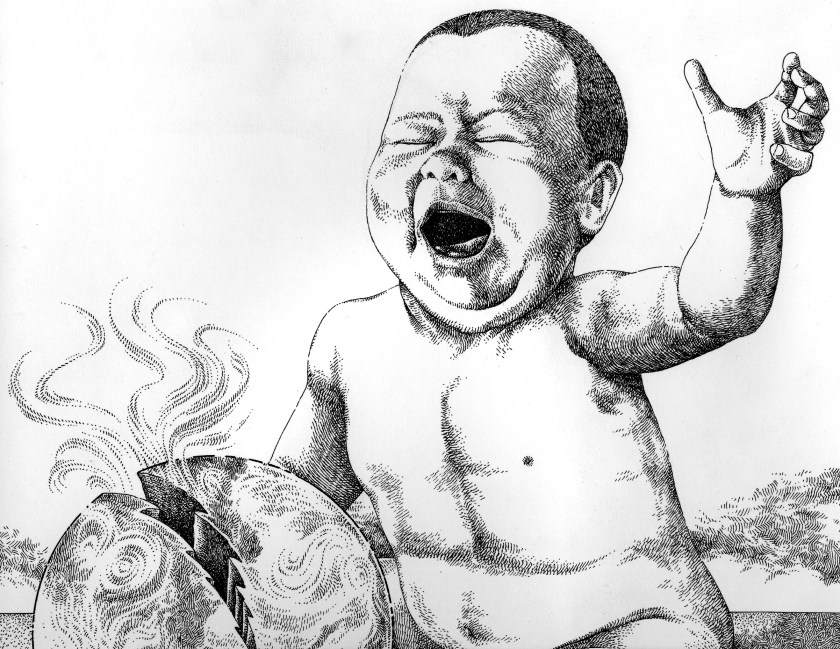
This drawing is all that survives from my first, fumbling attempt to write and illustrate a picture book. I never submitted it anywhere, but I learned a lot working on it.


This drawing is all that survives from my first, fumbling attempt to write and illustrate a picture book. I never submitted it anywhere, but I learned a lot working on it.
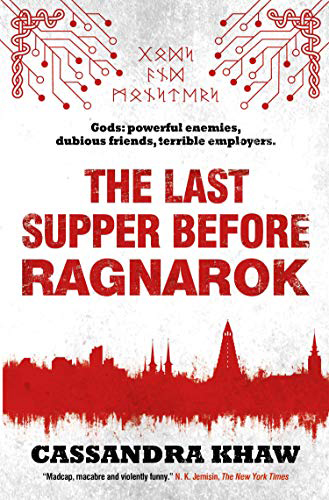
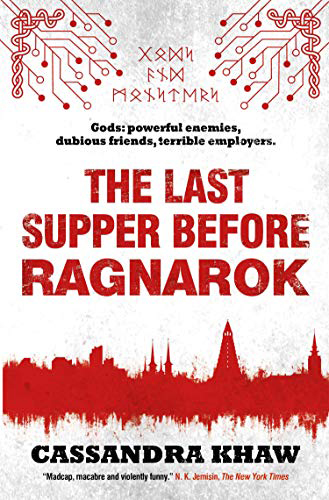
I first became aware of Cassandra Khaw and her novel The Last Supper Before Ragnarok on Twitter, where folks whose opinion I respect, many of them authors, raved about it. Turns out they were absolutely right!
One thing, though, right off the bat. Reading this novel was a sometimes disorienting experience for me. I felt like I was dropped into the middle of the story, and there were things I had to puzzle out, connections I had to make, character motivations I had to work to understand. As it turns out, that’s on me, because The Last Supper Before Ragnarok is actually the third novel in a trilogy, Gods & Monsters. I’m generally (okay, always) a stickler for reading a series in order, so I have no idea how I missed this. I blame my Kindle, where I tend to skip over the stuff I’d probably notice on a book cover.
Also as it turns out, it didn’t really matter, because I loved this book. What’s it about? Glad you asked! A ragtag group—a quasi-immortal chef who keeps dying but can’t stay dead, a god killer, a snake woman assassin, and a prophet, along with the entire internet personified as a young woman—road trip in search of the father gods, the ancient deities, in order to stop ragnarok. Apocalyptic mayhem, and several meals, ensue.
The real star here is Khaw’s prose. Thrilling, muscular, violent and anarchic, her language shimmers and shouts. There are laugh-out-loud moments of humor that punctuate the propulsive plot, and quietly heartbreaking moments as well. The Last Supper Before Ragnarok travels some of the same ground as Neil Gaiman’s masterpiece American Gods, but it definitely does not suffer in comparison. This novel could not be different in outcome or execution. Khaw is a writer of uncompromising skill, and she’s distilling real magic here.
I wish I had read this trilogy in correct order, but make no mistake, the first two novels will be heading to the top of my TBR pile.
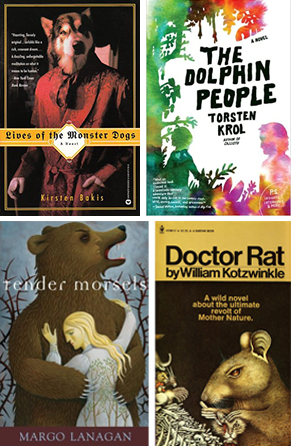

There are a lot of novels I’ve discovered, either by accident at the suggestion of others, that I think deserve a wider audience. Give these books a read, and give them some love!
LIVES OF THE MONSTER DOGS by Kirsten Bakis
I found a used paperback copy of this in a little bookstore in Greenwich Village, and was intrigued enough by the cover to take it home. Best decision ever. As it turned out, this was a New York Times Notable Book of the Year, so it’s not exactly unknown, but I never hear it mentioned. Isolated deep in a forest compound, a cruel but brilliant surgeon creates a race of monster dogs. Through Island of Dr. Moreau style experimentation, surgical butchery, and genetic engineering, the dogs gain human intelligence, the ability to speak and walk on their hind legs, even prosthetic hands. When the dogs overthrow their masters and make their way to New York City, they are at first the talk of the town. And then they are not. This entire novel is steeped in an at times unbearable melancholy, yet I couldn’t put it down. A true original.
THE DOLPHIN PEOPLE by Torsten Krol
A group of Germans near the end of World War II, enroute to a remote jungle outpost, crash land in the Amazon jungle and are taken in by a stone-age tribe. Whatever you think happens next based on that beginning, I guarantee you are wrong. This is the damnedest fever dream of a book, chock full of hallucinatory passages, nazi proselytizing, and a bravura sequence involving genital surgery that had me shaking my head in wonder. Pure, unadulterated lunacy of the finest kind. Look, just read this book and see for yourself.
TENDER MORSELS by Margo Lanagan
The very first piece of fiction by Margo Lanagan that I read was the short story “Singing My Sister Down“. If you haven’t read it yet, stop reading this and go find it online, I’ll be here when you get back. It’s a revelation. Lanagan has several collections of short stories, all of them excellent. Her novel The Brides of Rollrock Island is a stunning take on the selkie myth. But I digress. Tender Morsels tells the story of a young woman (a girl, really) who escapes her brutal life in a small village by living in her own personal fantasy world, where evil can’t reach her. That’s the bare bones, but it doesn’t come close to describing the wonders Lanagan achieves here. She writes about tough subjects like rape, abortion, and even quasi-beastiality in the heightened, evocative language of fairytales, walking a tightrope I think few authors could pull off. Lanagan is one of our very best writers, and Tender Morsels is one of my favorite novels ever.
DR. RAT by Willaim Kotzwinkle
In some circles, William Kotzwinkle may be best known as the author of the E.T. novelization. For others, it’s his novel The Fan Man, or his short story collection Elephant Bangs Train. Not me. For my money, his best work, his crowning glory, is the batshit crazy Dr. Rat, the story of the world-wide uprising of animals against humans, narrated by an insane laboratory rat. Part sustained howl against animal experimentation and the subjugation of animals by people, part war story as whales, elephants, and all the creatures of the wild go on the attack, and all of it filtered through Dr. Rat’s extraordinarily skewed intelligence. One of the best examples of an unreliable narrator I’ve ever read. There are moments here where Kotzwinkle’s language is positively incandescent.

My SUV gave up the ghost just outside Junction City
Left it there, no burial, I guess death is never pretty
Walked twenty miles through corn and wheat as far as the horizon
I know that it’s good exercise, but I wish I was still drivin’
Sad and sleepless in a Motel 6, waiting for the break of day
Out of luck, and that damn girl is still half a state away
She said,
Call me a dreamer, call me a fool
Prove that you love me as much as I love you
Come climb a mountain and lay down beside me
Follow the trail to the love deep inside me
Leave that life behind and start everything new
Come on, she said, let’s run away and keep on running for a while
I shook my head and silenced her with an absent, condescending smile
She was gone next morning, left behind a map from Triple A
That led to Colorado, where she wrote, “I’m heading this way”
And she left behind a letter that cut right to the heart
And I knew I better hit the road ’cause she had a good head start
So here I am with thumb outstretched and not a car in sight
But I think I crossed into Colorado sometime late last night
There’s a mountain in the distance that I know I’ll have to climb
You know, it’s worth the trouble if it makes that dreamer mine
She said,
Call me a dreamer, call me a fool
Prove that you love me as much as I love you
Come climb a mountain and lay down beside me
Follow the trail to the love deep inside me
Leave that life behind and start everything new

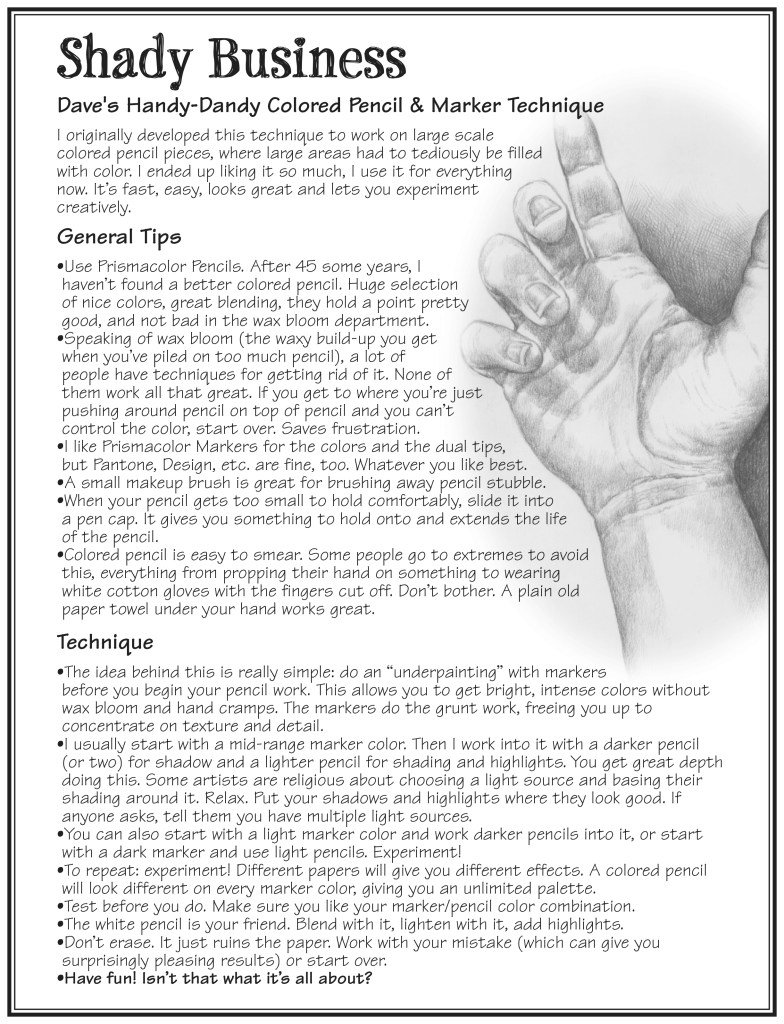
Back when I was designing rubber art stamps, my local stamp store (Hi, Ginny!) asked me to teach a class in coloring. Turns out, once stampers do their stamping, they sometimes like to color the resulting work. It also turns out that folks in the stamping community are uniformly delightful people, and the classes were great fun to do. This is a handout I prepared for the class, outlining some tips, and techniques that work for me. They may work for you as well.
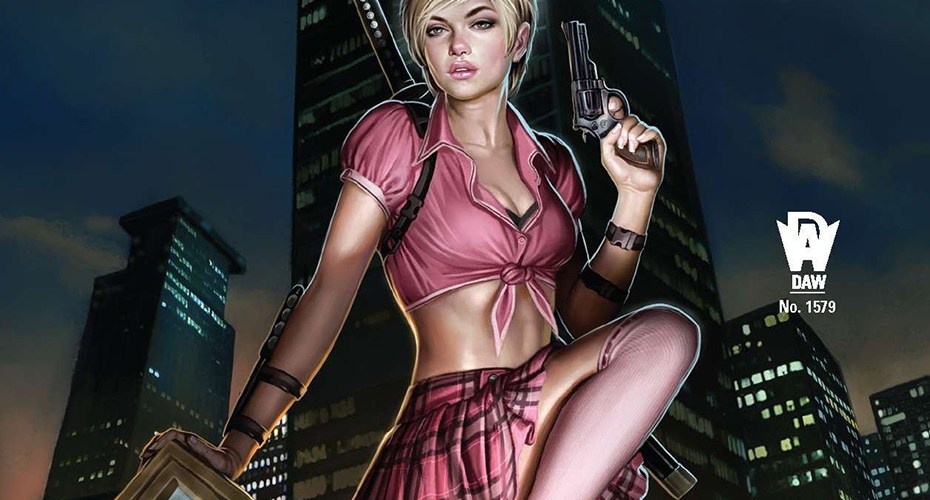
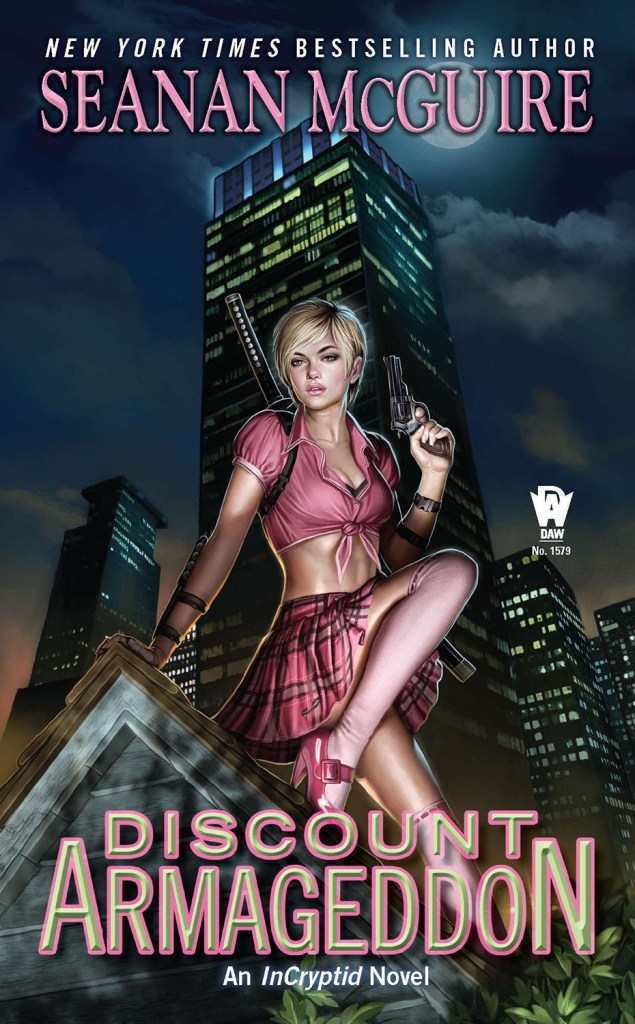
Seanan McGuire is so prolific, and so good, that it’s downright intimidating. She writes fantasy, science fiction, and horror (and for all I know tractor manuals) with equal excellence, under both her name and Mira Grant. Her fantasy work is audaciously imaginative, her science fiction grounded in solid, believable science, and her horror terrifying.
McGuire has several ongoing series (did I mention she’s prolific?), all of them excellent. The October Daye novels are urban fantasy at its best, set in a San Francisco where the lands of Fairy and humans intersect in exciting and delightful ways. The Wayward Children books are, in my opinion, the new yardstick against which all portal fantasies will be judged. And the InCryptid novels, of which Discount Armageddon is the first, are a whole other species of urban fantasy.
Discount Armageddon introduces us to Verity Price and her family of cryptozoologists, who for generations have been trained to keep the peace between humans and cryptids, the mythological creatures (some would say monsters) who live secretly, and sometimes not so secretly, among us. Verity is a fascinating badass—traveling the rooftops of New York City in her strip club cocktail waitress uniform, bristling with weapons, sarcasm always at the ready. Did I mention that in addition to monster protecting/fighting, Verity is a competitive ballroom dancer?
Meanwhile, New York’s cryptids are disappearing at an alarming rate, and Verity must figure out why. Her life becomes even more complicated when a member of The Covenant of Saint George arrives in town. The life mission of The Covenant is to eradicate every cryptid in existence, which puts him on a collision path with Verity. Mayhem ensues.
This is a fast-paced, exhilarating, and often very funny romp of a novel. The characters, both human and cryptid, are well-developed. We get to meet several other members of the Price family, each of them a badass in their own right. McGuire has done some first-class world building here—always believable, no matter how outlandish. This was the first InCryptid novel that I’ve read. I’m thrilled that there are now a bunch of books in the series, because I’m ready to dive back into this world.


I like poetry as much as the next fella. I even write some myself. But there’s something about a perfectly written song, a set of lyrics that speaks to your head and your heart, words that ride a melody like a longtime lover (or a brand new one), that makes me want to put pen to paper.
Here are some lyrics that speak to me, and, to be honest, lyrics I wish I had written. These were the first songs that came to mind. I’ve just scratched the surface. There are so many more, and I’ll probably do this again.
NEW YORK, NEW Y0RK Ryan Adams
I remember Christmas in the blistering cold
In a church on the Upper West Side
Babe, I stood there singing, I was holding your arm
You were holding my trust like a child
CAR WHEELS ON A GRAVEL ROAD Lucinda Williams
broken down shacks engine parts
could tell a lie but my heart would know
listen to the dogs barkin in the yard
car wheels on a gravel road
child in the backseat about four or five years
lookin’ out the window
little bit of dirt mixed with tears
car wheels on a gravel road
RICH MAN’S WAR Steve Earle
Bobby had an eagle and a flag tattooed on his arm
Red white and blue to the bone when he landed in Kandahar
Left behind a pretty young wife and a baby girl
A stack of overdue bills and went off to save the world
Been a year now and he’s still there
Chasin’ ghosts in the thin dry air
Meanwhile back at home the finance company took his car
Just another poor boy off to fight a rich man’s war
THE ONLY FLAME IN TOWN Elvis Costello
But you blew hot and cold
Turned my heart to a cinder
And with each passing day
You’re less tender and more tinder
Now you’re not the only flame in town
32 FLAVORS Ani Difranco
and god help you if you are an ugly girl
course too pretty is also your doom
cause everyone harbors a secret hatred
for the prettiest girl in the room
and god help you if you are a phoenix
and you dare to rise up from the ash
a thousand eyes will smolder with jealousy
while you are just flying back
EVERYBODY KNOWS Leonard Cohen
Everybody knows that you love me baby
Everybody knows that you really do
Everybody knows that you’ve been faithful
Oh, give or take a night or two
Everybody knows you’ve been discreet
But there were so many people you just had to meet
Without your clothes
Everybody knows
TENNESSEE Arrested Development
Outta the country and into more country
Past Dyesburg and Ripley
Where the ghost of childhood haunts me
Walk the roads my forefathers walked
Climb the trees my forefathers hung from
Ask those trees for all their wisdom
They tell me my ears are so young
Go back, from whence you came
My family tree, my family name
For some strange reason it had to be
He guided me to Tennessee
WHEN I WAS A BOY Dar Williams
I was a kid that you would like, just a small boy on her bike
Riding topless, yeah, I never cared who saw
My neighbor come outside to say, “Get your shirt,”
I said “No way, it’s the last time I’m not breaking any law.”
And now I’m in a clothing store, and the sign says less is more
More that’s tight means more to see, more for them, not more for me
That can’t help me climb a tree in ten seconds flat

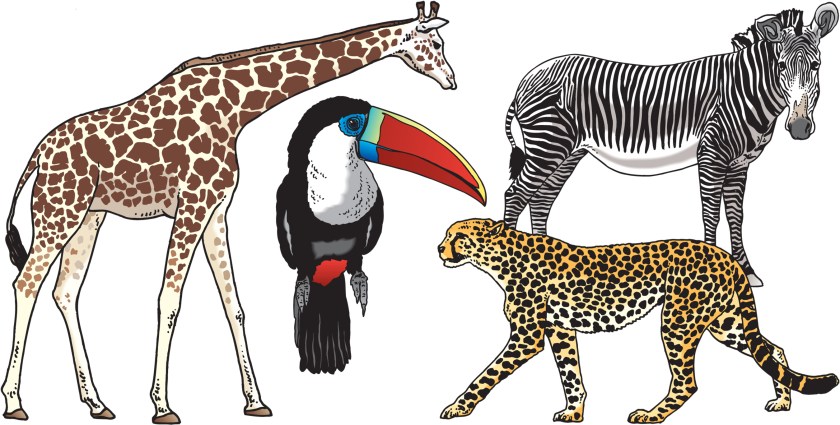
I drew dozens of zoo animals for a publishing company that creates products for zoo and museum gift shops. These were so much fun to do! Here are a few samples:

When I talk about my writing here on the blog, I’m talking about fiction writing. Whether writing for kids, or writing science fiction, fantasy or horror for adults, fiction is my favorite pool to splash around in.
What I don’t talk about much here is my day job, which I’ve done now for almost forty years. I’m creative director for a small, close-knit ad agency here in beautiful Cleveland, Ohio (And no, I’m not being sarcastic. I love this city, except for the weather.). Funny thing is, if I add up the minutes, I spend more time writing for work than I do at home. Don’t get me wrong, my main gig is graphic design, but in any given week I write radio and TV scripts, website copy, blog posts, print copy—the list is long. My co-workers are aware of my fiction writing, and insanely supportive, which is very cool.
The questions I find myself asking are these: Does the fiction writing make me a better advertising writer? Does the advertising writing make me a better fiction writer?
I don’t know for sure, but I think the answer to both questions is yes.
My fiction tends to the fantastic, to flights of fancy, often to humor. I lean on my imagination pretty hard. I would argue that all those things come into play when I’m writing advertising copy, because I try to look past the first, more mundane ideas, and aim for somewhere near left field. I might be selling sewing machines, or home heating and cooling systems, but that doesn’t mean I can’t find a fun and unique way to make that sale. The skills I’ve learned writing fiction help me do that.
Conversely, When I sit down to write fiction, the skills I’ve learned writing advertising copy come into play. I’ve had to learn to make a point clearly, succinctly, in as few words as possible, to describe something so that the mind’s eye can see and understand it. I find this really helpful when writing action scenes in particular, the ability to keep all the pieces moving without the story desolving into a muddy stew of imprecise verbs.
So, in a word, yeah. I think writing a lot makes me a better writer in both my day and night jobs.
I would love to get some other opinions here. Do you agree? Disagree? Let me know!

A few more life drawing sketches from high school and college.


Here are the bare bones: Two female time-traveling agents, Red and Blue, from the opposing sides of a war raging across time and space. They are, each of them, the very best at what they do, traveling up and down a vast complexity of multiple timelines, altering events both mind-bogglingly large and infinitesimally small. They commit the wholesale slaughter of entire armies, then change the path of a single wandering monk. Both are playing an unfathomably long game that stretches across thousands of years.
If you read the above description, you might mistake this novella for rather old-fashioned, hard science fiction, something that could have been written by Heinlein, or maybe Bester.
Nope. This is a different and much wilder animal.
See, as they work the timelines, braiding and unbraiding events, the agents become aware of each other. They begin to leave notes, letters, for each other to find, at first taunting, then showing a certain grudging respect for each other’s skill, and finally, haltingly, love. This Is How You Lose the Time War becomes, at least in part, an epistolary novella, and the most unusual, ravishing love story I’ve ever read.
Take, for instance, those letters I mentioned. Yes, some are written by quill, in longhand. But some take forms by turn whimsical and scarifying—in birds, in seeds, in lava flows, in words that can be ingested into the body.
What sets this novella apart, and one of the reasons I think it was recently nominated for a Hugo, is the language. El-Mohtar and Gladstone are working in rarified air here. The words leap and dance off the page, incandescent, intoxicating, alive. There were moments here where I was a little adrift, not exactly sure what I was reading, and I never gave a damn. I just went with the flow of the story, let it wash over me, and came out the other side.
Whatever I say, I can’t possibly do This Is How You Lose the Time War justice. Just read it, fall in love with Red and Blue, and get lost in the best possible way.
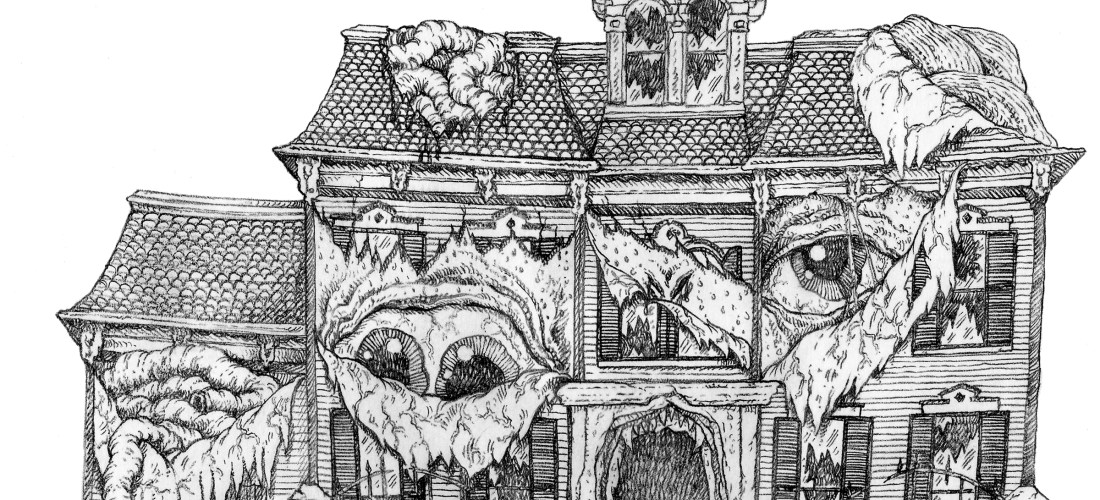
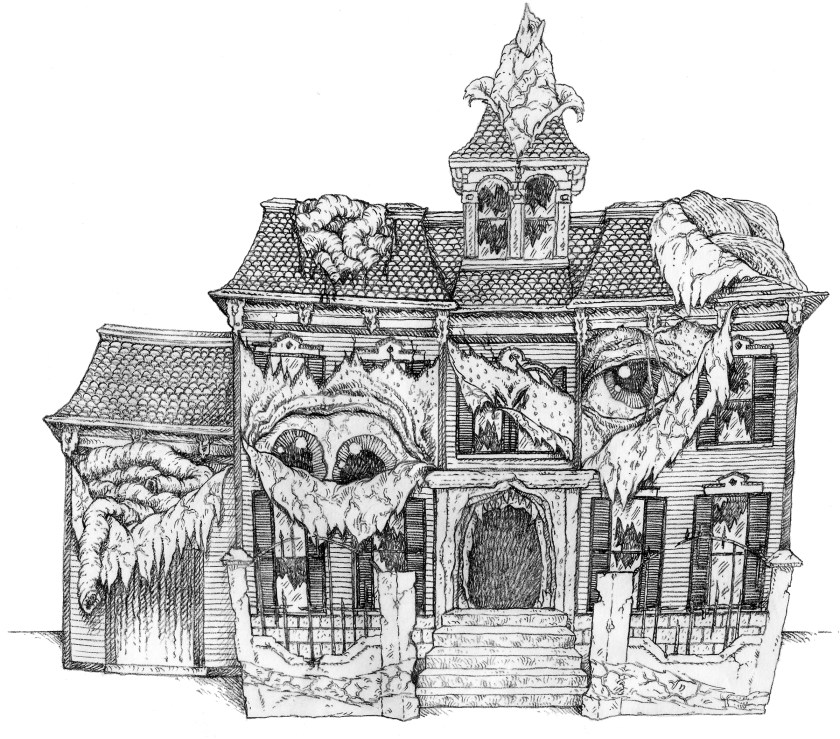
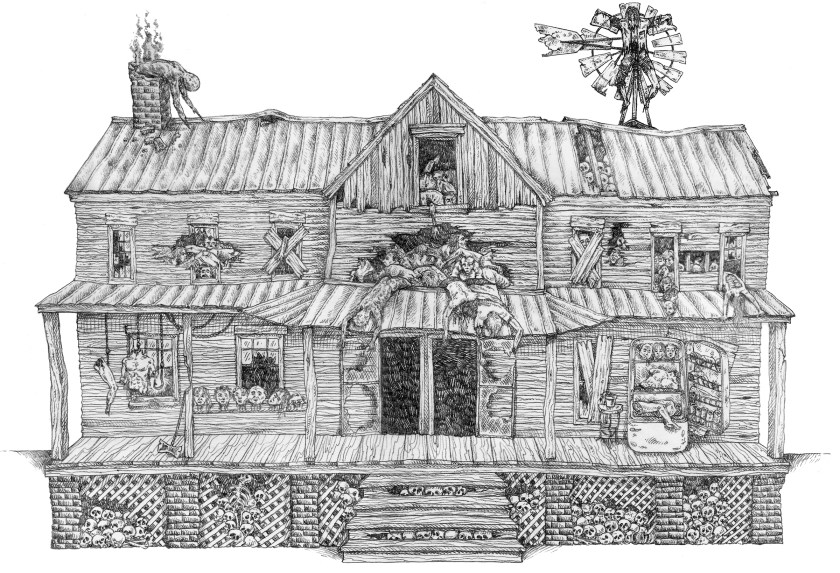
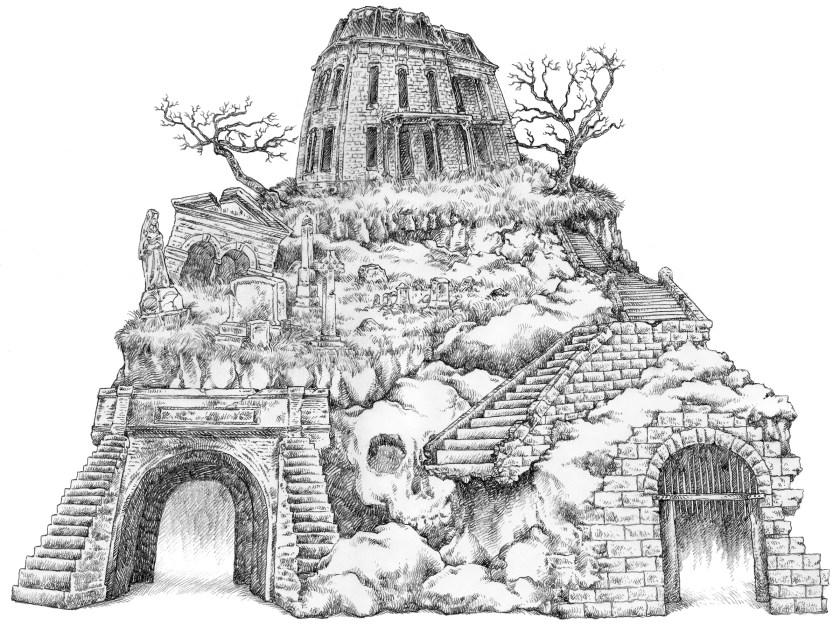
I posted these to my Twitter a while back, but I think they’re worth a blog post. I was hired to design haunted house facades by a company that fabricates them for the industry. These were a ridiculous amount of fun to work on. I call these Victorian Skin, Cannibal Farmhouse, and Haunted Hill.

This is an old piece, from way back in high school. Charlie Chaplin and Jackie Coogan in a movie called The Kid.


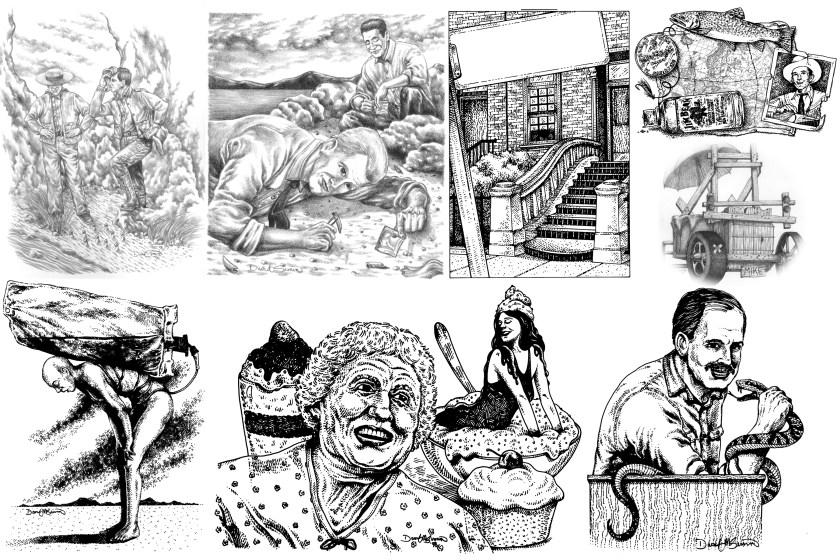
I’ve done a decent amount of magazine illustration work over the years. Here are a few samples. These originally appeared in Alfred Hitchcock Mystery Magazine, Now & Then, Gold & Treasure Hunter, and New Renaissance.
Look at you now,
sprawled out on the floor.
Tried to reach the bathroom
only made it to the door.
When you left last night
you were looking so fine,
I would have told anybody
I’m so proud that he’s mine.
Now your tie’s around your head
and your shirt’s buttoned wrong,
and I can see from your position
that your underwear’s gone.
You were too drunk to remember,
and now you’re too cool to care,
and you’d like to ask me what you did
but baby you don’t dare.
Now, that lipstick’s such a pretty color,
but it’s not one you should wear.
You were too drunk to remember,
and now you’re too cool to care.
The cops left here
about an hour ago.
From the story they were telling me,
you put on quite a show.
I understand the bloody nose–
sounds like you saw some stars.
But where’d you get that haircut,
and where the hell’s the car?
You left home with a Rolex–
Now you’re wearing Mickey Mouse.
From the buzzing cloud above your head,
you’ll have to be deloused.
You were too drunk to remember,
and now you’re too cool to care,
and you’d like to ask me what you did
but baby you don’t dare.
My bags are packed, I’m leaving,
and I would probably tell you where,
but you were too drunk to remember,
and now you’re too cool to care.
My bags are packed, I’m leaving,
and I would probably tell you where,
but you were too drunk to remember,
and now you’re just too cool to care.
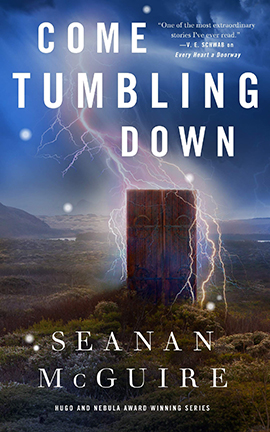
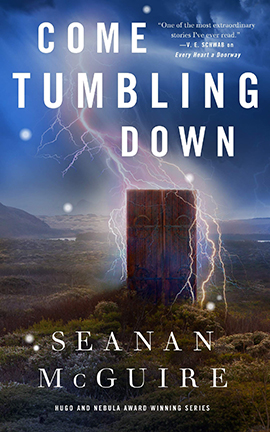
Portal fantasy is a well-loved trope in the literature of the fantastic. The basic idea—a person (or persons), almost always a child, is transported to another world through some sort of magical door, or mirror, or rabbit hole— has been around forever. From the Alice books to The Chronicles of Narnia, from Howl’s Moving Castle to Peter Pan, from The Wizard of Oz to Cat Valente’s Fairyland books, from Percy Jackson to Akata Witch, portal fantasies exist because they provide such a useful entry point, such a sturdy scaffold on which to construct a magical world.
To all of those books, even your most treasured, I say make room. Seanan McGuire’s Wayward Children series, of which Come Tumbling Down is the fifth entry, has set a new standard in portal fantasies. The first novel, Every Heart a Doorway, asked an intriguing question—what happens to all those children when they return from magical worlds. In that novel we were introduced to Eleanor West’s School for Wayward Children, the place those children end up when their parents don’t know how to deal with them, and to several of the kids now trying to make their way through our drab, disappointing world after having left the magic behind.
Through the subsequent novels—Down Among the Sticks and Bones, Beneath the Sugar Sky, In An Absent Dream, and now Come Tumbling Down—we visit some of those worlds and see them through the eyes of characters we’ve come to know and care for. The stories are by turns funny and heartbreaking, whimsical and terrifying, and always deeply humane. McGuire has a true gift for thoughtful inclusion. Even in the most outlandish of circumstances, her wayward children are all fully realized characters, their virtues balanced by flaws, their pain and yearning always deeply felt. McGuire’s world building is rigorously thought out. Even her nonsense worlds make internal sense.
I realize that this review of Come Tumbling Down hasn’t really talked about the novel much. That’s okay. You should know that it continues the story of twins Jack and Jill, who we’ve already met in Every Heart a Doorway and Down Among the Sticks and Bones. You should also know that Come Tumbling Down is just as satisfying. My suggestion is that you read all the Wayward Children books, in order preferably, as each one does build, sometimes in subtle ways, on the last.
If a very few years McGuire has become one of my favorite writers. She’s nominated for several Hugo awards this year, including one for In An Absent Dream. Her novel Middle Game, also nominated, was one of my favorite books of 2019. McGuire is prolific, and has several series ongoing, but don’t be afraid to dive right in. The Wayward Children series is a great place to start.

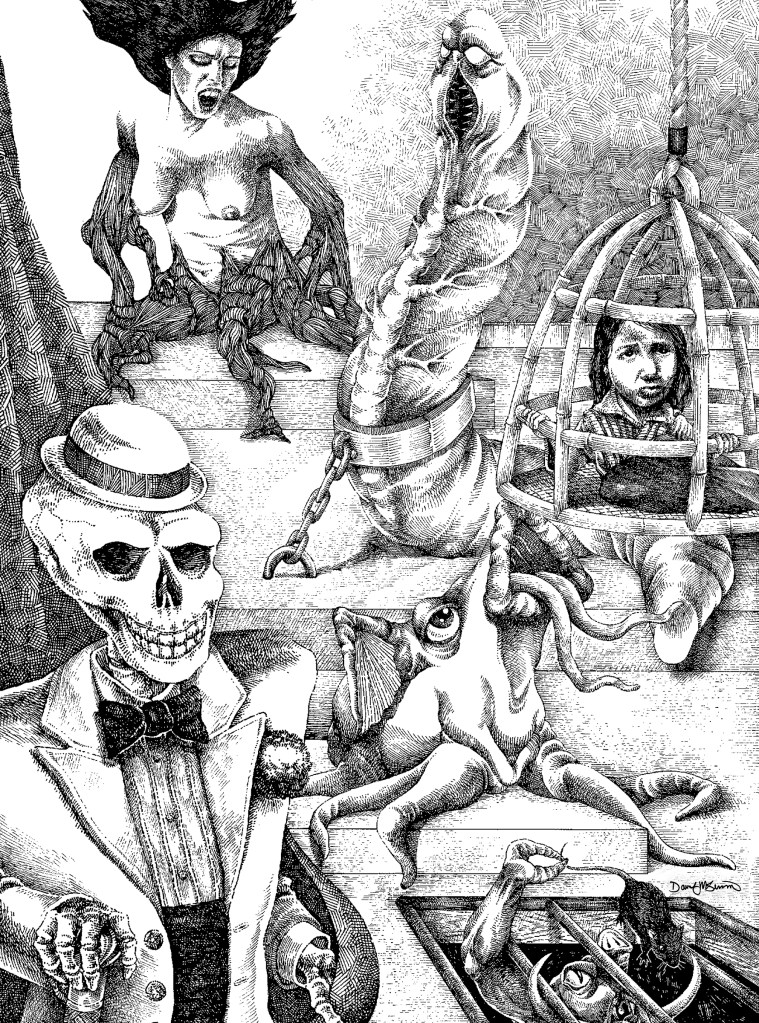
I love working in pen and ink, and this is one of my favorites of all the pieces I’ve done.
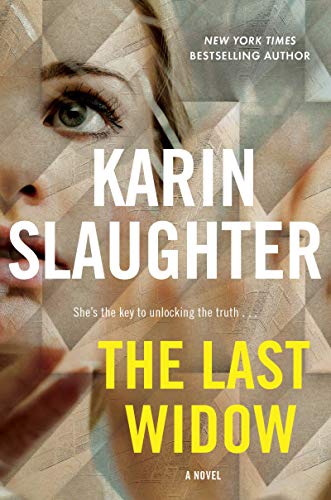

Anyone who reads this blog regularly has probably realized that I read mostly genre stuff, specifically science fiction, fantasy and horror. Once in a while, however, I don’t mind a good, taut thriller. Karin Slaughter’s The Last Widow is part thriller, part police procedural, and an altogether fun, sometimes nerve-wracking read.
The Last Widow concerns a terrorist attack, an off-the-grid white supremacist group, kidnapping, and an undercover government agent. Slaughter does a lot of things really well here. She seems to have a deep knowledge of how law enforcement works on both the local and national level, from city police to government agencies including the Georgia Bureau of Investigation and the CDC. Everything she details rings true. Grudging cooperation, inter-agency squabbles, heroics and bone-deep weariness, it’s all there.
The terrorists’ plan, particularly given the current state of the world, is relevant and terrifyingly plausible.
One final thing I’d like to mention is pacing. Slaughter does something I found extremely effective, almost cinematic. Bear with me as I digress here. Did you ever notice when watching Goodfellas that in the final quarter of the movie, as Henry Hill’s life unravels, the pacing accelerates, the scenes are shorter, choppier? Slaughter’s chapters in The Last Widow start out long and dense, and then get shorter, punchier, almost breathless, toward the end. It works like gangbusters.
Lulu has a plastic Jesus on the dashboard of her car
she likes to think that maybe he protects her
Lulu sees the eyes of angels when she looks up at the stars
she says that sometimes late at night the statue smiles at her
Lulu has a radio on the nightstand by her bed
she spins the dial, searching through the static
Lulu hears the voices of the saints around her head
she says that if they ever stop it would be so tragic
Lulu had a mother, hung herself in Lulu’s room
promised everlasting joy if she would join her soon
promised that the hand of God would pull her from the tomb
people say that Lulu’s mom was crazy as a loon
now they say the same about Lulu
Lulu has a bible that she carries like a shield
she parries each attack with verse and chapter
Lulu reads aloud from it as she walks across the fields
she says what others think just doesn’t matter
Lulu has a television, the on/off switch is crossed with tape
she says the devil lives behind the screen
Lulu turned it on just once, a very bad mistake
now she sees the devil in her dreams
Lulu had a daddy, used to visit Lulu’s room
Lulu would lay very still and look up at the moon
finally he just up and left, and not a day too soon
people say that Lulu’s dad was crazy as a loon
now they say the same about Lulu
Lulu has a scrapbook filled with clippings from the paper
she says the rapture hides between the lines
Lulu says she doesn’t really care if people hate her
the earthly ones are the only ties that bind
Lulu has a journal where she keeps her secret thoughts
she sits each night and writes ’til long past dark
Lulu keeps it locked up tight, afraid that she’ll get caught
she says she fears the dog that doesn’t bark
Lulu had a boyfriend, never came to Lulu’s room
the time he spent with Lulu was like watching a cartoon
he only ever held her hand, but people just assume
people started saying he must be crazy as a loon
he would never say the same about Lulu

People seemed to like the sketches I posted before, so here are some more. I didn’t mention it last time, but these are two-page spreads, with an open area for text on each spread.
Another round of favorite opening lines. Some of these are long, some very short, but all of them not only draw you in and make you want to keep reading, but tell you what kind of book it’s going to be.
THE PRINCESS BRIDE, WILLIAM GOLDMAN:
This is my favorite book in all the world, though I have never read it.
CARRIE, STEPHEN KING:
Nobody was really surprised when it happened, not really, not at the subconscious level where savage things grow.
THE MARTIAN, ANDY WEIR:
I’m pretty much fucked.
THE HOBBIT, J.R.R. TOLKIEN:
In a hole in the ground there lived a hobbit.
GOOD OMENS, TERRY PRATCHETT & NEIL GAIMAN:
It was a nice day. All the days had been nice. There had been rather more than seven of them so far, and rain hadn’t been invented yet. But clouds massing east of Eden suggested that the first thunderstorm was on its way, and it was going to be a big one. The angel of the Eastern Gate put his wings over his head to shield himself from the first drops.
2001: A SPACE ODYSSEY, ARTHUR C. CLARKE:
Behind every man now alive stand thirty ghosts, for that is the ratio by which the dead outnumber the living.
A HITCHHIKER’S GUIDE TO THE GALAXY, DOUGLAS ADAMS:
Far out in the uncharted backwaters of the unfashionable end of the Western Spiral arm of the Galaxy lies a small unregarded yellow sun. Orbiting this at a distance of roughly ninety-eight million miles is an utterly insignificant little blue-green planet whose ape-descended life forms are so amazingly primitive that they still think digital watches are a pretty neat idea.
A CONFEDERACY OF DUNCES, JOHN KENNEDY TOOLE:
A green hunting cap squeezed the top of the fleshy balloon of a head. The green earflaps, full of large ears and uncut hair and the fine bristles that grew in the ears themselves, stuck out on either side like turn signals indicating two directions at once. Full, pursed lips protruded beneath the bushy black moustache and, at their corners, sank into little folds filled with disapproval and potato chip crumbs. In the shadow under the green visor of the cap Ignatius J. Reilly’s supercilious blue and yellow eyes looked down upon the other people waiting under the clock at the D.H. Holmes department store, studying the crowd of people for signs of bad taste in dress. Several of the outfits, Ignatius noticed, were new enough and expensive enough to be properly considered offenses against taste and decency. Possession of anything new or expensive only reflected a person’s lack of theology and geometry; it could even cast doubts upon one’s soul.
THE BOOK OF LOST THINGS, JOHN CONNELLY
Once upon a time – for that is how all stories should begin – there was a boy who lost his mother.
THE MAGICIANS, LEV GROSSMAN
Quentin did a magic trick. Nobody noticed.

No idea why I never finished this, as I like the direction it was heading. But, that ship has sailed and I’m not going to finish now. I think it’s worth sharing, however.

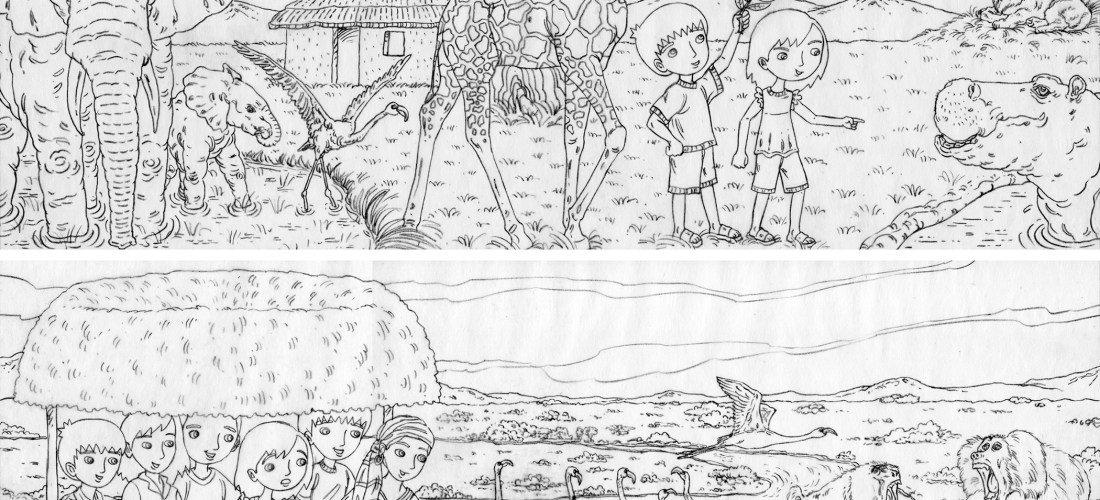
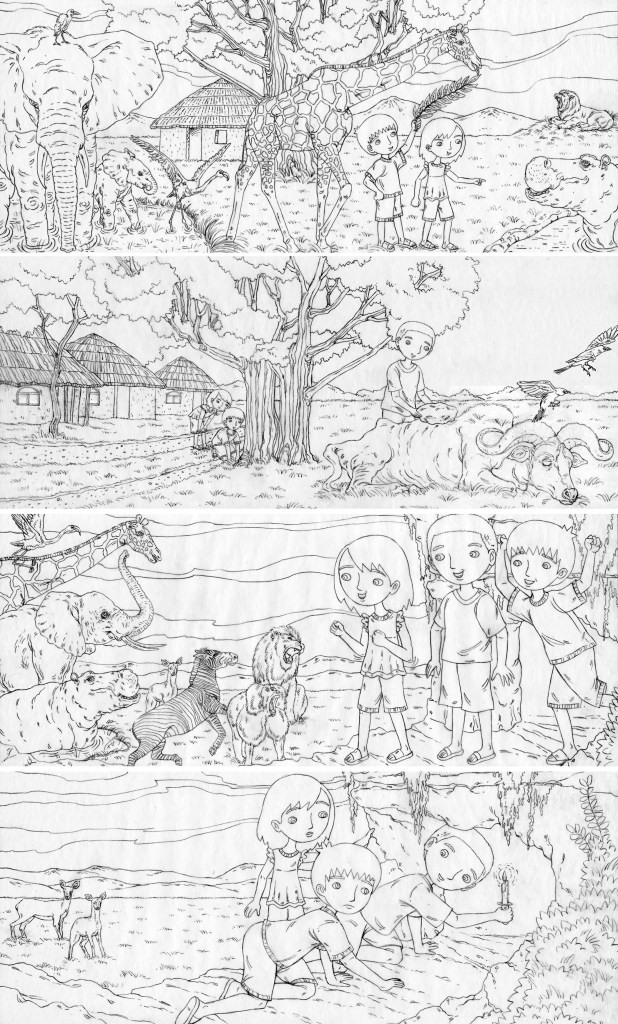
I worked on a picture book set in Kenya for the same publisher I did the Galapagos book for. The project fell through, but here are some of the sketches. This was fun—so many animals!

Do you remember the TV show Inside-Out Boy? It was an excellent piece of claymation that ran on Nickelodeon for a few years in the late 80s/early 90s. Fast forward to a couple of decades ago, and I had an idea for some new stories set in the Inside-Out Boy world. Not content to sit on an idea I liked, I wrote a few spec scripts, and hunted down the production company that had produced the original series. As it turned out, they liked it. We started talking about the possibility, and it was a slim possibility, that we could move forward with the idea. Then…then 9/11 happened, and they were in New York, and that was it. But I still like the idea. Here’s one of those spec scripts.
Inside-Out Boy In:
The Grass Is Always Greener On The Inside-Out
SCENE: Bird’s-eye view of a suburban neighborhood at dusk; kids playing, lawns being mowed. This wholesome vision is shattered by the sound of a—
YOUNG GIRL’S VOICE
Help! Leave me alone, you bullies!
CUT TO: An access alley behind a garage with garbage cans, etc. Two punky looking teenage boys are teasing a cute young girl (Carla). They have taken her bike.
CARLA
Give me back my bike or I’ll tell my dad!
BOY A
Ooooh, I’m really scared! She’s gonna tell her daddy!
BOY B
Not if we put her in a garbage can…come on, Stu, let’s get her…
They approach her menacingly.
CUT TO: Close-up of Carla, looking terrified, as the shadows of the boys fall across her. She trips and falls.
CUT TO: The two boys approaching, from Carla’s P.O.V.
VOICE FROM OUT-OF-FRAME
Hey! Why don’t you dorks pick on someone your own size!
The punks look around puzzled.
BOY A
Who said that?!
VOICE FROM OUT-OF-FRAME
I did!
Inside-Out Boy leaps down from the garage roof, landing on top of a garbage can. He waves his arms and sticks out his tongue at the boys, making loud noises, exploiting his inside-out-ness. The punks become scared little kids and run away screaming. Inside-Out Boy watches them go.
INSIDE-OUT BOY
Hah, that’ll teach ‘em.
I.O.B. turns back toward Carla, and really sees her for the first time.
CUT TO: Close-up of Carla’s face as I.O.B. sees her…she’s a blonde vision, light radiating from her face.
CUT TO: Close-up of I.O.B.’s face with a dumb smile and faraway eyes. He is clearly smitten.
CUT TO: I.O.B. kind of shakes himself, realizes he’s staring. He reaches to help Carla.
INSIDE-OUT BOY
Here, let me help you up.
Carla recoils from his touch, tries to hide the look of revulsion that crosses her face but does not succeed. She scrambles to her feet, keeping her distance. This is one girl who does not think I.O.B. is cool.
CARLA
No, no, that’s okay. I’m fine, really.
Carla hurries past him, jumps on her bike. She pedals away, one bent wheel squeaking.
CARLA (OVER HER SHOULDER)
Um, thanks and everything.
CUT TO: Close-up of I.O.B. He realizes what has just happened.
INSIDE-OUT BOY (TO HIMSELF)
Wow, she was scared of me. I, I think I grossed her out!
CUT TO: I.O.B. walking home, slumped and dejected, as indignities are heaped upon him. Dogs and cats follow him, sniffing. A bird lands on his head, begins to peck. An elderly woman carrying a big pie to her neighbor sees him, screams and flips the pie up in the air; naturally it lands on his head.
INSIDE-OUT BOY (HOWLING TO THE HEAVENS)
I’m tired of being inside-out!
A gopher pops his head out of his hole, sees I.O.B., lets out a loud EEEK and dives back into his hole. I.O.B. hangs his head and sighs.
DISOLVE TO: The next day at school, I.O.B. sits in class, still grumbling. His teacher enters with Carla in tow, and I.O.B. perks up immediately.
TEACHER
Class, say hello to your new classmate, Carla Calloway.
CLASS (HAPHAZARDLY)
Hello, Carla…
TEACHER
Carla, why don’t you find yourself a seat.
I.O.B. realizes there is an empty seat next to him. He looks at Carla and smiles hopefully. Carla sees him and ducks her head. She heads for a desk on the opposite side of the room. I.O.B. drops his head on his desk.
DISOLVE TO: I.O.B. eating lunch with his best friends; Darcy, who lives next door, and Thomas, a bit of a nerd who thinks of I.O.B. as his own personal science project. I.O.B. gazes longingly across the cafeteria at Carla.
DARCY (TO THOMAS)
What’s with him?
THOMAS
He’s in love with that new girl, Carla, but she thinks he’s gross!
INSIDE-OUT BOY
Shut up, Thomas!
Darcy looks daggers at Carla. She’s been carrying a quiet torch for I.O.B. for years. She thumps I.O.B. on the head to get his attention.
INSIDE-OUT BOY
Huh? Ow! What?!
DARCY
If Blondie over there can’t see what a cool guy you are, even inside-out, then she’s not worth the time of day!
INSIDE-OUT BOY
You’re just saying that ‘cause you’re my friend.
DARCY
Ooooh!
Darcy storms off, upset.
INSIDE-OUT BOY
What’d I say?
THOMAS
Man, you really have a way with the ladies.
INSIDE-OUT BOY
Shut up, Thomas!
DISOLVE TO: Later that day, after school. I.O.B. and Thomas sit on the playground swings, talking.
INSIDE-OUT BOY
Where’s Darcy?
THOMAS
She went home. She’s still cheesed off at you. You know she kind of likes you, right?
INSIDE-OUT BOY
You’re crazy! Me and Darcy have been friends forever!
THOMAS
Yeah, whatever.
They sit in silence for a moment, I.O.B. deep in thought.
INSIDE-OUT BOY
Hey Thomas…I don’t want to be inside-out any more. Can you find a way to change me back?
THOMAS
Are you sure?
INSIDE-OUT BOY (DETERMINED)
Yeah, I’m sure.
THOMAS
Well, I love a challenge. Let’s go to the lab.
DISOLVE TO: Thomas’s room. It’s a nerd’s paradise, with computers, test tubes, Bunsen burners, etc. Thomas is wearing a lab coat, the pocket bristling with pens. I.O.B. looks apprehensive.
INSIDE-OUT BOY
Now what?
THOMAS
(WITH A BIG SMILE ON HIS FACE…
HE’S BEEN WAITING TO DO THIS FOR A LONG TIME)
We have to run some tests.
Collage of scenes, one dissolving into the next, as I.O.B. is subjected to all manner of silly tests while Thomas takes notes. He’s poked and prodded with odd-looking instruments. He’s hung upside-down and spun in circles. He hops on one foot while holding a goldfish bowl in one hand, balancing an umbrella on his nose and singing “Row, Row, Row Your Boat.”
CUT TO: Thomas pressing the ENTER button on his computer keyboard, while I.O.B. looks on, exhausted.
THOMAS
Keep your fingers crossed, here it comes.
A sheet of paper slides out of the printer. Thomas picks it up, not letting I.O.B. see it.
THOMAS
Hmmmm…why didn’t I think of that?
INSIDE-OUT BOY
What? What’s it say?
THOMAS
You have to swing up over the bar backward.
INSIDE-OUT BOY
You’re kidding…
THOMAS
Nope.
INSIDE-OUT BOY (WITH CONVICTION)
Let’s do it.
DISOLVE TO: The swing set. I.O.B. takes his seat as Thomas and Darcy look on.
DARCY (STILL MAD)
I hope you know what you’re doing. What if you turn inside-out again? You’ll end up being a big gooey mess.
INSIDE-OUT BOY
I’m already a big gooey mess…besides, that’s not going to happen, right, Thomas?
THOMAS
Um, right. At least, I don’t think so. So, you ready?
INSIDE-OUT BOY (HOLDING ONTO THE CHAINS)
Yep.
Thomas and Darcy get in front of I.O.B. and each grab a side of the swing. They back up, pulling the swing forward as far as they can.
THOMAS
On three. One, two, threeeeee!
They rush forward, flinging I.O.B. backwards. The swing goes up in a big arc, almost parallel to the ground, before heading back.
INSIDE-OUT BOY
Almost, keep pushing!
Thomas and Darcy keep pushing, the swing inching higher and higher.
CUT TO: Close-up of I.O.B. as he finally loops over in slow motion, upside down, chains slack. As he comes over the top he begins to transform, turning right–side out. He comes to a bouncing stop, looks down at himself and lets out a loud
INSIDE-OUT BOY
Yeah! It worked!
Thomas and Darcy join him in cheering.
THOMAS
I knew it would work! At least, I was pretty sure. Science triumphs again!
DARCY
So now what? You going go tell your family?
INSIDE-OUT BOY
Yeah, they’re really gonna be surprised!
DISOLVE TO: Mom and dad hugging I.O.B. in a stranglehold.
MOM
Oh honey, we love you no matter what. Plus, now I can take the plastic off the furniture.
CUT TO: I.O.B. with his little sister, Shelly. She pokes him experimentally.
SHELLY
Hmmm. You’re not sticky anymore. I’m gonna miss that.
She looks at him with a frown, then bursts out laughing and hugs him.
SHELLY
Just kidding!
CUT TO: I.O.B.’s big brother Steve. He looks I.O.B. up and down, then bops him on top of the head and walks away.
STEVE (OVER HIS SHOULDER)
Inside-out or not, you’re still a dweeb.
I.O.B. sighs, rubbing his head, then smiles.
INSIDE-OUT BOY (A LITTLE SARCASTICALLY)
There’s no place like home…but now there’s a certain blonde girl I have to go see.
DISOLVE TO: I.O.B. in a jacket and tie, a bouquet of flowers in his hand. He’s obviously nervous as all get-out as he walks up the porch steps of a nice house and rings the doorbell. Carla answers the door. She looks at him dismissively through the screen door.
CARLA
Can I help you?
INSIDE-OUT BOY
Um, yeah, I mean yes. (HOLDS OUT THE FLOWERS) These are for you.
CARLA
Who are you?
INSIDE-OUT BOY
It’s me, the kid who saved you when those older boys took your bike. I guess I look a little different now. Anyway, I was wondering if you’d like to go to a movie or something.
CARLA
As if. So you’re not inside-out any more, I still don’t owe you anything. You really thought I’d go out with you? Yuck!
Carla slams the door in I.O.B.’s face. I.O.B. slinks away, crushed, and the night just gets worse. He runs into the elderly woman who had the pie before and tries to scare her out of spite. She hits him with her umbrella. A gopher pops up out of his hole and bites him on the ankle. Finally, as he crosses an alley, the two punks from before grab him up, pulling him into the darkness. We hear loud banging sounds, then the punks exit the alley, dusting off their hands, laughing.
CUT TO: I.O.B. in a garbage can, banana peel and miscellaneous trash on his head.
INSIDE-OUT BOY (DEFEATED)
I guess there’s only one thing left to do…
DISOLVE TO: The playground, late at night. I.O.B. peeks up from behind some bushes, scanning the playground. He zips from bush to tree like a ghost, making his way toward the swingset. When he’s sure the coast is clear he gets on the swing.
INSIDE-OUT BOY
Here we go again!
I.O.B. begins to swing, higher and higher. As he climbs into the sky, his determined frown is gradually replaced with a smile. Finally, with a triumphant yell, he loops over the top and turns back inside-out. He leaps off the swing, plants his feet and raises his hands into the air.
INSIDE-OUT BOY
Inside-Out Boy is back!
DISOLVE TO: The next day in the school cafeteria. I.O.B., Thomas and Darcy are sitting together, I.O.B. inside-out as can be. Thomas is shaking his head.
THOMAS
I just don’t get it. I can’t figure out why you turned back inside-out.
INSIDE-OUT BOY (WITH A SLY SMILE)
It’s a real mystery all right.
DARCY
So what’d your family say?
INSIDE-OUT BOY
Oh, you know. Steve bopped me on top of the head, Shelly loves me no matter what, and Mom put the plastic back on the furniture. I guess life is back to normal. So who wants to hit the playground for some kickball?
THOMAS
I’m in. Darcy?
DARCY
You guys go on, I’ll be there in a minute.
Darcy reaches into her pocket and pulls out a big, juicy worm.
INSIDE-OUT BOY
Darcy, what’s that for?
DARCY
That Carla girl is looking a little pale. I think she needs more protein in her diet, so I’m gonna add this to her spaghetti.
Darcy and Thomas high-five.
THOMAS
You go girl!
DARCY
No one messes with my boy—best friend. (SHE BLUSHES)
CUT TO: Close-up of I.O.B., a big embarrassed smile on his face.
INSIDE-OUT BOY
Shut up, Thomas.
THOMAS
I didn’t say anything!
INSIDE-OUT BOY
You were going to…
THE END

I think the name for this one kinda speaks for itself.
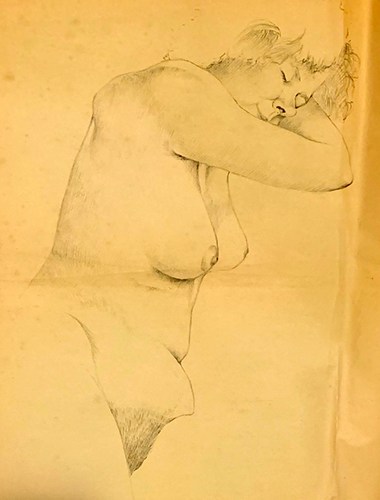
I suppose there are pluses and minuses to being a packrat. Here’s a plus…I was cleaning out an old portfolio and found some life drawings from college, thought I’d share.


I never tried my hand at a ballad before, and this may not be the usual subject matter for the form, but it was really fun to write.
they say there’s a corner of heaven reserved
for priests, politicians and barkeeps
we spend our time helping the people we serve
though sometimes their problems run chin deep
I’ve tended this bar for near twenty years
and I’ve seen more than I care to tell
I suppose that I’ve poured out an ocean of beer
and drunk more than my share as well
I’ve heard the confessions of killers and fools
and downed shots with a couple of saints
I’ve had punks strut in who thought they were cool
and watched them leave knowing they ain’t
of all the nights spent with one eye on the till
and one ear with some clown on the make
there’s one magic moment that stays with me still
one memory I can’t seem to shake
a hard rain had pounded the city all evening
and business had been pretty slow
one hand on my coat, I was planning on leaving
when a voice at the door said, don’t go
an old woman entered with slow, measured steps
took a stool at the end of the bar
her gaze when I caught it was none too direct
like the road she had traveled was far
I gave her some time to get settled in
a good bartender knows not to hurry
one good look at her face told me she favored gin
and I could see every bottle she’d buried
I’ve got a small problem, she said in a whisper
I had to lean close just to hear
if you’d pour me a drink I’d be grateful, mister
but I don’t have a penny to spare
the thing is, I’m not one for charity
I can set things right, given the chance
I offer you something of heart stopping rarity
if you stand me that drink, I will dance
I guess my face betrayed my thoughts
and she put me to the test
if you don’t know about it, you shouldn’t scoff
there was a time when they called me the best
the name I was born with is Mary McDevin
but my stage name was Trixie Delight
I gave more than one boy his first glimpse of heaven
and haunted a thousand men’s nights
then she slid off the stool and stood herself tall
walked arrow straight to the jukebox
she punched up one song, leaned back to the wall
and the whole damn place started to rock
she started off slow, just a sway to the beat
like each note was her own private lover
I will swear to this day she was giving off heat
and I thought about diving for cover
she threw off her coat with a flick of one wrist
shimmied out of her dress like a cat
and if someone asked me I’d have to insist
I no longer knew where I was at
I could blame it on the hour, or blame it on the beer
or maybe it was just a trick of the light
but I swear right now on what I hold dear
for that one brief moment she was Trixie Delight
the music faded and she quickly dressed
and an old woman sat down at the bar
I knew in my heart that I’d just seen the best
that I’d been entertained by a star
I poured her a double without saying a thing
and she knocked it right back like a pro
I was thinking about all of the joys this job brings
when Trixie said, it’s time to go
as she opened the door to let herself out
she turned and favored me with a wink
I may never know what that night was about
but I sure as hell know what I think
My son, Eric, is a third year high school English teacher. He wrote this as part of his final capstone project in college, just before starting full time student teaching. I think of this as his teaching manifesto. I asked him if I could share this, and I also asked him to write a followup on how it’s going, now that he’s been teaching for a few years.
Not Just Old, Dead White Men:
Adding Contemporary Young Adult Literature to the Secondary Curriculum
When one thinks of the traditional novels read in high school, many come to mind. From The Scarlet Letter, to The Great Gatsby, to the works of Shakespeare, students across the country are reading texts written before most of their teachers were born. In fact, often before their grandparents were born. While these texts have provided important themes and subject matter, many students have difficulty both comprehending and connecting with these canonical pieces of literature. Because of this, students are not learning to the best of their abilities. They are getting lost and frustrated in the writings of old, dead white men, instead of opening their minds with texts they can identify with. I believe that instead of strictly teaching these canonical texts, one should incorporate young adult fiction into the curriculum.
Young adult literature looks very different from canonical pieces. Many works of classic literature look very similar, with the exception of writers like Joyce and Pynchon, but those writers are not typically read in high school. Young adult literature today, on the other hand, covers an incredibly varied number of formats, and often traffics in genres like science fiction and fantasy. Some contemporary young adult literature has nothing to do with genre at all, not an alien civilization or dystopia in sight, but the difference is, the story is set in today’s world, with characters the students can relate to. And if the characters are not like them, they are at least their contemporaries. Students can easily identify with the novels, and with characters who are like them, more so than with canonical texts. This leads to students actually reading the assigned books, and learning more.
When one reads a canonical piece, the formatting is often essentially the same. There will be a narrator telling their story, set in some historical setting. There is nothing really unique about them. For the most part, these classic texts look the same to today’s student readers. This is in sharp contrast to what is currently popular. As an example, take the novel Miss Peregrine’s Home for Peculiar Children, written by Ransom Riggs. The novel is built around vintage photos that both catch the eye and propel the story forward. This helps the student identify the plot and themes. As James Serafini says, “Using storyboards to simultaneously display images from a novel allows readers to focus on the images and design features necessary to construct meanings.” This method of writing works to engage the student with the text. A student connects with this kind of writing more than a canonical piece. Samantha Beatty, an eighth grade teacher at Wellston Middle School, in Wellston, Ohio, teaches this novel. She says, “Miss Peregrine’s is a text that is very popular at this age, and is something that my students really enjoy reading. The students connect with the text and its themes, allowing an excellent learning environment.” Because the students connect with the text so well, learning is not only easier, but it makes it fun, and fun translates to reading more. That is one of the most important facets of adding young adult literature to the curriculum.
I mentioned that young adult literature looks very different from canonical texts. Books like The Hunger Games trilogy, or the Divergent series, present dystopian worlds that are clearly offshoots of our own. At the time of this writing, six out of the top ten novels on the NY Times Young Adult Bestseller List use dystopias as their settings. This is not just escapist literature. These novels, and many like them, use the dystopian setting to talk about important things like the corruptive threat of power, the role of media in society, the danger of totalitarianism, even religion. All in a palatable way that should be included in the curriculum. Instead of trying to jam something like The Great Gatsby down student’s throats, a book set in a world few of today’s teenagers can identify with (unless those teenagers live in Beverly Hills), including a novel that students can connect with helps them learn better.
Traditionally, guys like reading novels about guys, and many girls like reading novels about other girls. One issue that canonical texts face is that many of them are strictly geared towards the young men in the classroom. Many of these novels are written by men, about men, and for men. Even when the writers are women, the results are often the same. Very few canonical pieces feature a female character that young girls can look up to, and identify with. Novels like The Scarlet Letter and Jane Eyre feature a female lead character whom many consider to be weak; not exactly a role model for today. Without a lead character to identify with, many young girl students lose touch with the novel. However, young adult literature is a place where many young girls can find a character to look up to, to emulate. Hermione, Katniss, Tris, Eleanor; these characters are all powerful young women who make excellent role models for students, male or female. For teenage readers without good role models at home, they may turn to fiction to find their heroes. This is almost impossible to find in canonical pieces, so incorporating young adult literature into the curriculum fills an important role.
Why should one include young adult literature into the curriculum? Well, at one Chicago high school, “Student’s don’t audibly groan when they whip out their books at the start of English class” (Eldeib). Many students have trouble connecting to canonical texts, either because of the language it is written in, or the content. Young adult literature can change all of that, as many of the themes are the same as canonical texts. Young adult literature “Can be just as complex as classic canon, but can be more accessible and relatable” (Connors). This is an important point made by Connors, as it shows that young adult literature should be fully encompassed inside the realm of traditional texts. It is important that teachers instill upon their students that reading is important. Some believe that “The THAT of teenagers reading is more important than the WHAT” (Gibbons). In this day and age, with computers and iPhones and the internet, with videogames ever more popular, literacy is something that slips through the cracks sometimes. Young adult literature can help increase literacy. Instead of high school students just reading The Scarlet Letter, full of purple prose, moralizing, and what people today would call slut shaming, you can pair it with Jennifer Mathieu’s The Truth about Alice. This novel covers the same themes as The Scarlet Letter, but in a much more accessible way. Reading a young adult literature take on a canonical piece, specifically pairing them together, gets students interested and able to identify with both novels.
Traditionally, resources such as SparkNotes, CliffsNotes, and No-Fear Shakespeare have been the bane of the teacher’s existence. These resources allow students to take the easy way out, and not actually read the texts that are assigned. They just read the shortened version, try to pass the quiz or test, crank out a paper, and forget about it completely. One of the best parts of teaching a contemporary young adult novel is that often a SparkNotes has not been created for it yet. As Connors says, “…Used to promote close reading, which is considered essential for standardized tests”. Because the students do not have anywhere to go for answers but the text, they will be forced, at first through necessity but later through their own wanting, to closely examine the text. Students will have “discussions… [that] are an essential part of what happens within our classrooms nearly every day” (Roberts). Having full class, or small group discussions about the text opens students’ minds to what others think, and makes them really explore the text on their own accord. Using young adult literature truly opens new doors to students.
Some feel that the current Common Core Exemplar Novels are dated. In fact, a survey done by S. Wolk, as quoted by Rybakova, says that, “Of the top ten books read in secondary schools nationwide, Shakespearian plays make up 30%, and of the top texts, one was written by a White woman; all other texts were written by White males. The most recent book that students read out of the canon is To Kill a Mockingbird, published in 1960”. It has been 56 years since the latest novel was added to the canon. The world has changed by leaps and bounds in that time, and yet, the literature students read in school hasn’t. That is an issue; this is why young adult literature should be supplementing these texts. How are students expected to identify with characters and events that were written decades before they were born? The literature taught in classrooms needs to change with the students, not be held rigidly in place. A changing of the guard needs to happen, at least partly.
I am not saying that canonical pieces should be completely replaced, quite the opposite in fact. Young adult literature should be taught in conjunction with canonical texts. Many canonical pieces are part of the Common Core Exemplar lists, because of their importance as pieces of literature, and their importance to society. However, many young adult texts cover the same themes, in a more modern way that is relatable to teenagers. Look at The Catcher in the Rye, by J.D. Salinger. Catcher is a classic novel, read in junior English classes across the country. Its main theme, of the struggle of growing up, and the loss of innocence, is still extremely applicable to students everywhere. However, it was written in 1951, when the world was very different than it is today. Holden Caulfield’s big loss of innocence in the novel is seeing the F-word written on a wall. However, in this day and age, that word is regularly said even in elementary school playgrounds across the country. The standards are different now than when Catcher was written. For those students who have trouble identifying with Holden Caulfield, there is a very suitable companion novel. The perfect novel to pair with The Catcher in the Rye is Steven Chbosky’s The Perks of Being a Wallflower. It takes the very same themes of growing up and the loss of innocence, but makes it more relevant for students. These novels are perfect to pair together, and can be used for close reading, and comparative essays. Pairing these two texts is an excellent way of blending the canon with the new.
To Kill a Mockingbird is one of the most famous novels of all time, has themes that transcend time, and is still exceedingly relevant today. Racism is sadly alive and well; this is one novel that has aged well. But even To Kill a Mockingbird has a contemporary pairing. Monster, by Walter Dean Myers, is about a young African-American teenager on trial for felony murder. The novel focuses on racism in modern day New York. Monster is something that students can really relate to, as the main character is a teenager, instead of a young girl, like Scout. This pairing does an excellent job of combining the canon with the new, and is something that helps students learn.
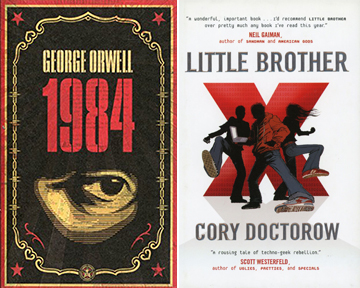
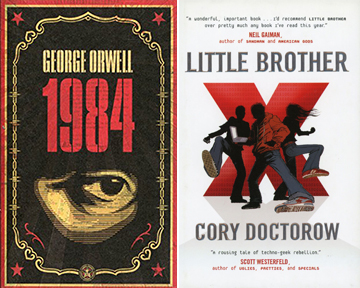
Another pairing that should be done is the classic 1984, by George Orwell, with the newer Little Brother, by Cory Doctorow. The conversation about government surveillance is currently at a fever pitch, with the San Bernardino shooter’s phone unlocking case dominating headlines. 1984 has never been more relevant. At the same time, Little Brother encompasses all that 1984 does, but it does so on the bleeding edge of technology, using words and ideas teenagers live with every day. Using both of these novels, in conjunction with current informative and non-fiction news articles, would make for an excellent unit that once again blends the canon with young adult literature, while keeping it relevant and interesting for students.
Chadwick and Grassie recommend first picking a theme, such as civil disobedience, and then finding both a canonical text and a contemporary piece to accompany it. In the case of civil disobedience, a classic work is Thoreau’s Civil Disobedience, which is a common text to read. However, instead of just reading that, one could accompany it with any of Cesar Chavez’s speeches. Chavez also offers an ethnic approach. Additionally, one could use any number of speeches from the Black Lives Matter movement, to give civil disobedience even more of a current twist.
As has been said before, the canon should not be replaced; only supplemented. While some students really do enjoy the classics, many others have a difficult time getting into these novels. Fisher outlines several techniques that are very useful in teaching these difficult canon texts. The first is that modeling is a fantastic technique to help students learn.
Students need to hear their teachers thinking aloud about complex texts. These events should provide them an opportunity to witness how another person works to understand the text. Importantly, teachers have to understand what made the text complex if they are going to effectively model aspects of text complexity. For example, if the sentence structure contributed to the complexity, then the teacher needs to model how she works to make sense of those sentences.
By modeling and using think aloud, students observe the proper way to dig into a difficult text. This method is extremely helpful for those students who are visual/auditory learners. Modeling is an excellent way to help students with difficult texts. Another technique is annotating. Fisher says that by color-coding as one underlines or circling words and phrases one doesn’t understand, or which appear to be key points, is very helpful (Fisher). A combination of modeling and annotating is one of the best ways to help students attack a text, and are great methods to use when using a difficult text.
Young adult literature is not always accepted in every classroom. In fact, some believe that young adult literature has absolutely no place in the English classroom. Gibbons says that “… young adult literature lacks sophistication and literary merit. Teachers in our study indicated that YAL does not have the qualities of canonical texts, and, therefore, will not help students to meet the same curricular objectives”. However, young adult literature can have incredibly complex themes that more than hold up to scrutiny, and are more than able to add value to the curriculum. If one were to look at a novel like The Hunger Games, one could dismiss it immediately as young adult escapism that adds nothing to the conversation. However, on closer examination, strong themes like the power of sacrifice, the importance of standing up for what one believes in, and even civil disobedience in the face of a corrupt government are evident. I think even Thoreau would find something of value in Katniss’ struggle. This contemporary novel has very complex themes that more than hold up under a microscope. Young adult literature has a lot of value in the modern day English Language Arts classroom.
Young adult literature has a lot of value in the classroom, if only teachers are willing to work with it. I recognize this would go against the grain in many school districts, and I do not think it could happen all at once. There are definitely challenges involved. For instance, when considering book pairings, one such pairing I thought of brought up something that should be briefly discussed. Go Ask Alice by Beatrice Sparks with Cruddy by Lynda Barry. Both are heartbreaking and harrowing looks at drug addiction. But Cruddy, while one of the most deeply moving novels I have ever read, is also unsparing in its depiction of drug use, sex and violence. Books like this, and Bastard Out of Carolina by Dorothy Allison, and even His Dark Materials trilogy by Philip Pullman because of the treatment of organized religion, would be wonderful to teach, but could also lead to censorship challenges. In my view, the benefits would be more than worth the risk, but I recognize that this is one more thing a teacher must consider.
Baby steps may be necessary. I look forward to taking those baby steps when I become a teacher, and eventually giant steps, because I believe strongly that this is the best way forward to promote literacy and make fiction relevant to kids today. It makes many themes and ideas accessible to students, and for some it can instill a lifelong love of reading. While the canon has become that for a reason, adding young adult literature to it, not replacing it, is the key to an incredible, and incredibly relevant, ILA curriculum.
Not Just Old, Dead, White Men: Revisited
I wrote the above essay when I was a starry eyed, completely inexperienced 22 year old potential teacher, completing one of the last classes before I student-taught. In the five years since then, I’ve taught at two very different schools, and thought a lot about my ideals as a teacher, specifically relating to literature.
Let’s be honest here: Many English teachers get into the profession because they have both a love of literature, and at the very minimum, a desire to work with high schoolers every day, and help them learn and grow for the future. Graduating college, I knew that I was going to struggle to reach at least some kids with literature, kids who had never picked up a book willingly in their lives. Sadly, that was a takeaway from student teaching. My hope was that teaching more contemporary literature would help these kids embrace reading.
The first school I taught at, fresh out of college, was different than most. It was a boarding school for kids with emotional or behavioral disorders. Each of these students, while mostly of above average intelligence, all had issues that prohibited them from learning well at a traditional school. At this school, educationally, I could teach literally whatever I wanted. I was lucky enough, in my time there, to teach both a science fiction literature class, and a horror in literature and film class, two passions of mine. I was given the freedom to adjust my curriculum as I saw fit, and because of this, most of my students were highly engaged readers. This led to many in depth discussions and analyses during class, and ultimately led to them better understanding the meaning behind the content, the reasons why.
I also taught traditional 12th grade English during my time there, but in that case I had to follow the lead of my co-teacher. My co-teacher was using a very traditional curriculum, and while I thoroughly enjoyed it, my students seemed a little lost until we were able to make connections to their world, to build bridges between the novels we read and their lives. Students today almost demand more current curriculum, just to engage them. Something I’ve found to be true so far in my few short years of teaching, is that the more students trust you, and enjoy the content you bring to them, the easier it is to get them to listen. However, not all, or even many, schools allow a teacher to teach whatever they please.
My current school has a very interesting background that affects some of my curriculum. It’s a relatively new school that has only been operating for about nine years. It was originally started by families who came from a biblical cult that has since ceased operation. This means that some topics, even as straightforward as evolution, really anything “slightly controversial” (I once got a small talking to for showing a documentary on Auschwitz while reading Night), are almost completely off limits. For example, I originally wanted to teach The Handmaid’s Tale, which I consider a brilliant work of fiction, as well as a novel that is easily relatable to modern society. That did not go over well. Additionally, my girlfriend, who also teaches at the same school, wanted to teach Monster, which is commonly read in ninth grade. That was also denied, for being too real. For my ninth and tenth grade classes, I am required to stick to the essentials. Shakespeare, To Kill a Mockingbird, 1984, and the like. I try my best to connect these texts to the modern world for my students, but it isn’t always effective. I have a little more freedom with my upper grades, and I can teach just about whatever I want in AP Lit, but it can be a struggle.
This year, after literal begging from my tenth graders, I convinced my principal to allow me to teach something more modern. We read Cory Doctorow’s Little Brother, as a companion piece to 1984. In short, I was given the chance to test out my college ideals. This unit was done to great success, as the students had a very easy time identifying with the novel, the themes, the characters, everything. It led to some incredible conversations in class. I was lucky I was able to do something that could really show my students off.
Looking back on everything, I still have a very long way to go to really implement what I want to do. I know it depends on the administration, on the location of the school, and so many other things. I want to stress that in many ways this is a wonderful school to work for. Their academic standards are rigorous, and the students post some of the highest test scores in the state. My students in particular are doing very well. What really matters in this day and age is to get students engaged. And so far, in my very early teaching career, teaching literature that is relevant to the students is one of the easier ways to accomplish it.

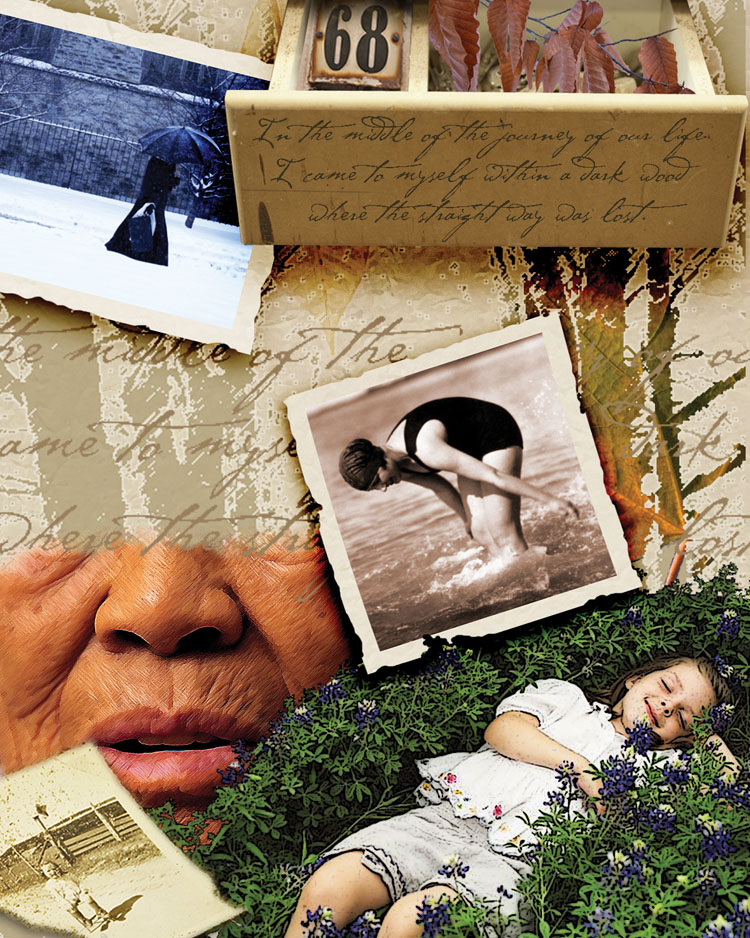
Back when I was designing rubber stamps for a company called Stampers Anonymous, I also created some digital collages for their in-house catalog. This is one of my favorites.
1.
standing on the broken summit of the hilltop
surrounded by his disciples
the mad prophet rants
feet planted in hellfire
head spinning in a fever dream
hecklers come to laugh at the crazy-eyed fool
in the death-dusted robe and the halo of pity
who is overstepping set bounds
scorn for a man who does not know the limits
the sky shatters
opens great cracks and rends in the clouds
that slowly reveal the night sky
disciples chant at the insane stars
the hecklers inch back from the frenzy
the mad prophet opens his eyes
hear me
he screams at a world
that for him is coming apart at the seams
hear me
he shouts at the lost sheep who cower about him
i am god!
a tear opens in the sky
allows passage for a searing bolt of lightning
a moment later an acrid stench and a rumbling echo
the crowd slowly disperses
no praise for wind-blown, smoldering ash
2.
now there are more
and the light in their eyes is a secret shade of madness
the hecklers scoff from hidden places
hesitant
not sure if the limits matter any more
afraid that the boundaries have been forgotten
in place of the death-dusted robe
a legion of uniforms
gold buttons and blood-stained medals
the halo of pity has been thrown to the wolves
and the odds have been evened
thousands of turrets
and shafts and gleaming barrels
that catch and splinter the sunlight
banks and rows and bunkers and stockpiles
all pointed bristling at the sky
that say
more eloquently than words
we are god!
fingers poised over switches
punch down in savage haste
all the sounds of destruction fill the air
the machineries of war clash
tangible grinding against intangible
the oceans erupt in their rocky basins
the hot lands shake apart
the walls of the world tumble down
the walls of heaven fall away
and nothing left in either place
3.
a cockroach struggles up
through ash and rubble
and decaying layers of the past
it breaks through to the surface
stretches to full height against the pale red sky
looks about with slow comprehension
says in a small brittle voice
i am god?
there are none left to refute it
 Dave Writes and Draws