BOOK REVIEW: KATABASIS BY R.F. KUANG

Reading

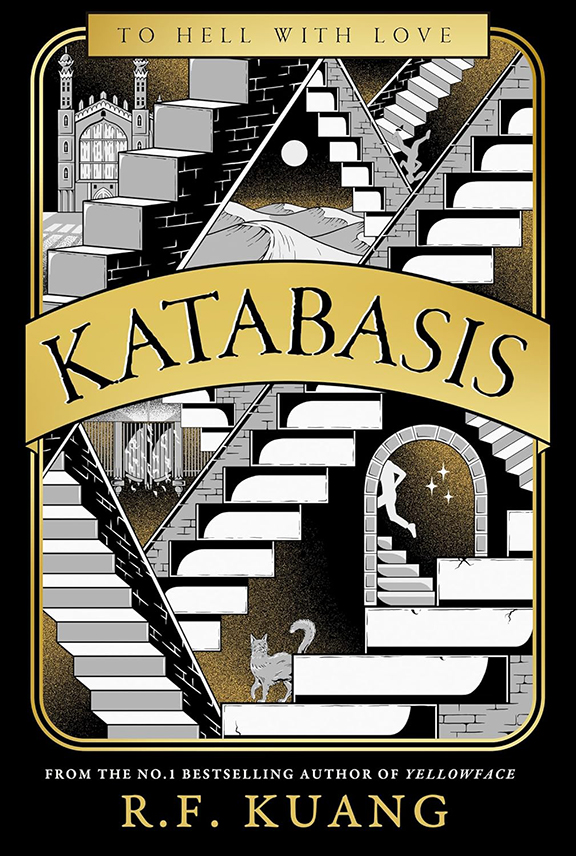
I have to start off this review with a public apology to my son, Eric. Let me explain. He’s an ex-high school English teacher and current Phd student, and we have nearly the same taste in reading. Oh, he reads a little more epic fantasy than I do, and I probably read a little more horror than he does, but honestly, we overlap about 98%. And he’s been telling me to read R.F. Kuang for years. I have Yellowface, Babel, and The Poppy War on my shelf, I’ve heard nothing but wonderful things about her, and I kept meaning to, but, so many books, so little time and all that. So finally he plopped the Broken Bindings edition of Katabasis in my hands—damn, they do beautiful editions—and pleaded with me to read it.

Damn, he was right. Katabasis is one hell of a book, and I mean that literally.

Alice and Peter are rival grad students at Cambridge in a world much like ours, except for one important detail…magick is real, it’s a field of study, and Alice and Peter are determined to be masters in the field. When their professor Grimes, who happens to be one of the world’s most legendary magicians, dies in a magical accident that Alice just might have triggered, the two students travel to hell to bring Grimes back.

Yes, is this world traveling to hell is indeed possible. The tales of Orpheus, Dante, and others are guidebooks rather than fictions. Alice and Peter are armed only with the knowledge they’ve gained at Cambridge, and enough chalk to sketch the Pentagrams for the spells they may need to survive.

What follows is a phantasmagorical masterclass in imagination and world building. Hell is nothing like the traditional fire-and-brimstone underworld. It’s a surreal, layered, constantly shifting landscape that in some ways holds up a mirror to the sometimes absurd and cruel vagaries of academic life at Cambridge. As Alice and Peter make their way through the eight courts of hell, they are tested physically, mentally, and spiritually. They face formidable opponents; deadly, ingenious traps; and challenges that force them to confront their own deepest insecurities, rivalries, and obsessions.

This is bravura level writing that is fiercely intelligent, breathtaking, and sometimes surprisingly funny. While reading Katabasis I caught echoes of Jonathan Strange & Mr. Norrell, Piranesi, and His Dark Materials, but make no mistake—Kuang has created a world all her own. This novel is a must read for any fan of dark academia, or, really, any fan of fantasy, period.

Like I said, Katabasis is one hell of a book.

GRAPHIC NOVEL REVIEW: SAGA, VOLUMES 11 & 12, WORDS BY BRIAN K. VAUGHAN, ART BY FIONA STAPLES

Reading

I don’t read enough graphic novels. There, I said it, and the truth is I say it every year, but here we are. As both a writer and artist, I have a deep appreciation for storytelling where the art and the words elevate each other and soar to ever greater heights. Since 2012, Saga has constantly, continually, reached and exceeded those great heights.

And yes, I know that Saga is technically a comic book, but since I read the trade paperback collected volumes, it’s a long-running graphic novel to me. That’s my take and I’m sticking to it.

Saga is science fiction, fantasy, and family drama, all mixed into a glorious stew. It’s a war story between two groups, the Horns and the Wings, with always shifting alliances. But part of the genius of what Vaughan and Staples do is that, while the war is always in the background, and sometimes in the foreground, they concentrate on the true heart of the story—Alana, Hazel, and Squire. We get to see the world—make that worlds—through their eyes. Their joys. Their heartbreaks. Their tenacity in the face of sometimes overwhelming odds. And as always, Hazel’s narration, her asides, provide crucial information.

In Volume 11, Hazel and her family are living on the street, struggling to survive. Meanwhile, the return of dangerous characters from their past threaten their existence.

In Volume 12, Alana has accepted a potentially deadly new role amidst shifting political alliances, and Hazel has made a new friend that changes their family dynamic.

As long as Vaughan and Staples are willing to continue this audacious, intoxicating high-wire act of creativity, I will be there for it. If you haven’t yet discovered the magic that is Saga, do yourself a favor and do it. I promise you won’t be disappointed.

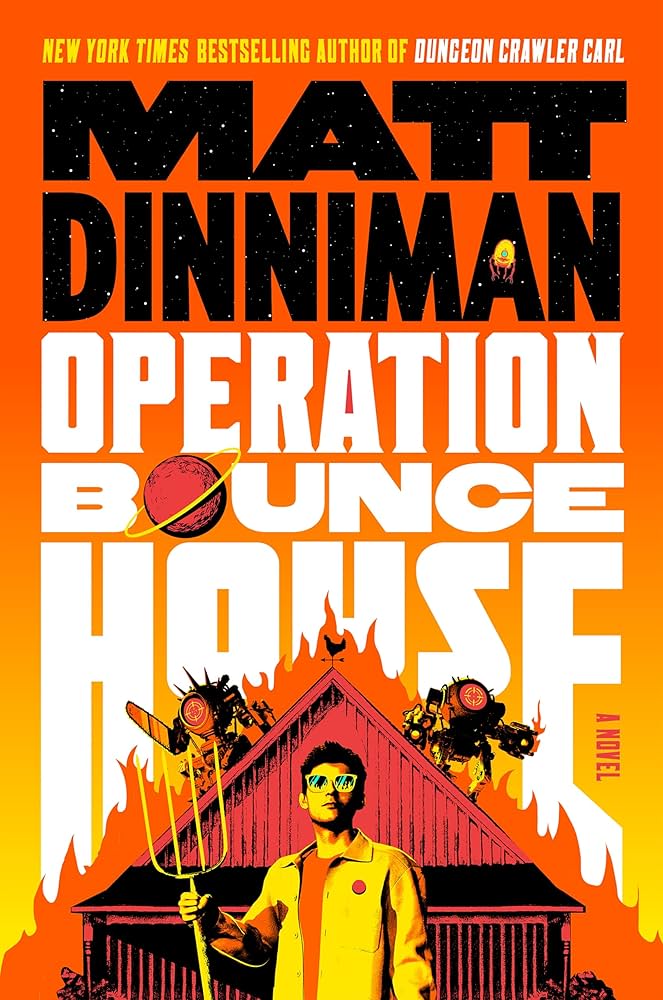
ARC REVIEW: OPERATION BOUNCE HOUSE BY MATT DINNIMAN

Reading

I haven’t read the books Matt Dinniman is most famous for, the Dungeon Crawler Carl series. I’ve heard nothing but raves about those novels, but as I’m not much of a gamer (I still firmly believe that the finest video game ever created was Mario 64), I wasn’t sure they were for me. Still, when an ARC of Dinniman’s new, stand-alone novel became available and I read the description, I was intrigued, and I took a chance.

I’m so glad I did, because Operation Bounce House is a ton of fun.

New Sonora is a planet far from Earth, colonized by humans from generation ships that left the home planet hundreds of years ago. Despite many setbacks, some of them catastrophic, the largely agrarian civilization is thriving, due in part to the guidance of the AI intelligence and agriculture bots that help run the family ranch where most of the story takes place. The settlers are looking forward to a transfer gate finally opening, which will give them instant travel to, and communication with, Earth.

And then everything goes to hell, when the settlers are attacked by war machines piloted by remote gamers back on Earth, thanks to a game called Operation Bounce House. The settlers much come together and fight for their lives against advanced technology and overwhelming odds, with only their ingenuity, their bravery, and a mediocre rock band to save them.

Dinniman excels at creating fully-realized characters you’ll root for, and does some truly exceptional world-building. And somehow, while building tension, amidst life and death stakes, he manages to inject laugh-out-loud humor when you least expect it. Like I said earlier, Operation Bounce House is a ton of fun.

This novel reminded me, in the best ways, of authors like Heinlein and Varley, and novels like The Forever Way, Old Man’s War, Ender’s Game, and Armada, but Dinniman has his own story to tell, and he does it well.

Operation Bounce House will be published February 10, 2026, and is available for pre-order now. Don’t miss this one.
BOOK REVIEW: MEMORIALS BY RICHARD CHIZMAR

Reading

I know Chizmar through Chasing the Boogeyman, a riveting serial killer novel, and the Gwendy’s Button Box trilogy, a wonderful set of novels that leapfrog through various genres. Two of the Gwendy books were written with Stephen King, and speaking of King, he says, on the cover of Memorials, that Chizmar’s stores are, “creepy, eerie, and propulsive. Noboby does suburban horror better.”

When it comes to Memorials, King, who knows a thing or two about horror, couldn’t be more right. This is a creepy, compulsively readable novel. The setup is fiendishly simple: three college students set off on a week-long journey into the Pennsylvania backroads to film a documentary on roadside memorials. The three students, two men and a woman, are thrown together by happenstance, but soon form an inseparable bond. Chizmar does a brilliant job of letting us get to know them, and like them, through their interactions with each other and the people they meet along the way.

As an aside, do you get nervous when a horror author makes you care about characters at the beginning, because you just know they’re going to do terrible things to them eventually. Just me?

Anyway, things soon take a sinister, unsettling turn, as their trip into the Appalachian countryside becomes filled with strange symbols, unexplained events, and locals who may not be what they seem. Chizmar takes his time, but sets the hooks in deep. Memorials is a dark, twisty thriller not to be missed.

BOOK REVIEW: NEVER FLINCH BY STEPHEN KING

Reading

By my count, Never Flinch is Stephen King’s 6th novel featuring the character Holly Gibney. It’s not my favorite Holly novel (that would be The Outsider) but it’s a solid and very welcome addition. At this point, I think Holly is one of King’s most successful creations, and I’m guessing by how often she’s appeared that he agrees.

Never Flinch follows two parallel tracks—a feminist speaker with a stalker who hires Holly to be her body guard, and a serial killer targeting innocent people in the name of a man who was unjustly imprisoned and subsequently murdered while incarcerated. While it takes a little while for King to set up his chess pieces, once the two stories begin to intertwine and come together, it’s a breathless and satisfying race to the end of the novel.

King brings back some characters we’ve met before, including Barbara and Jerome, and introduces some new ones—police officer Izzy Jaynes and soul singer Sista Bessie in particular. King is still a master at creating characters that you’ll either root for or hate. And there’s no one better at ratcheting up tension.

Chances are, if you’re a King fan, you’ve already read Never Flinch. If not, give it a read. It’s a good one.

BOOK REVIEW: KING OF ASHES by S.A. COSBY

Reading

I rarely read two books by the same author back to back—so many books, so little time, pesky things like working and sleeping getting in the way—but it happened with S.A. Cosby’s one-two punch of Blacktop Wasteland and Razorblade Tears. Here was an author writing crime fiction as good as anyone in the business, with ferociously feral criminals and flawed but deeply human good guys. Set in Virginia, Cosby’s stories are lean, violent, and relentless. He’s not afraid to tackle tough subjects like racism and homophobia. Call it southern gothic or gritty noir, Cosby is a modern master of his craft.

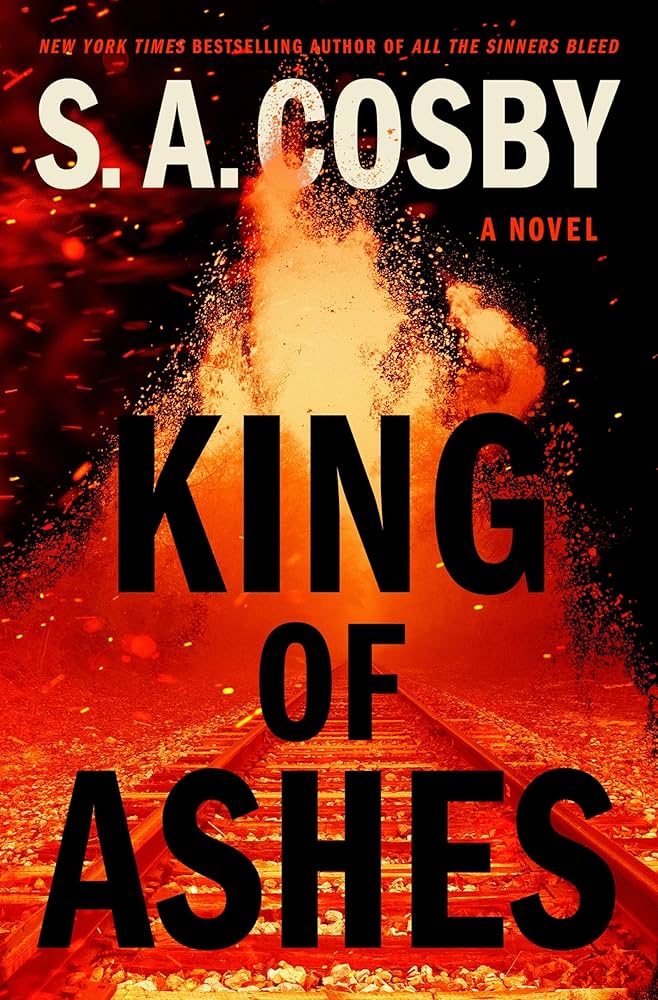
Like its predecessors, King of Ashes is set in Virginia, in this case the crumbling, crime-ridden town of Jefferson Run. When his father is severely injured in a car accident, Roman Carruthers is drawn home to Jefferson Run from his glitzy life in Atlanta as a financial planner for the rich and famous. There he finds his sister Neveah desperately trying to keep the family Crematorium business from going under, and his drug-addicted brother Dante in debt to a pair of psychotic brothers who hold the town in their bloody grip.

Roman soon finds himself deeply involved in the brothers’ criminal enterprises, trying against all odds to keep his brother and sister alive. Roman is no stranger to bending the law for his high-end financial clients, but this is something all-together different. As the bodies begin to pile up, the furnace at the Carruthers Crematorium is working overtime, and Roman finds himself crossing lines he never thought he would cross.

Cosby reminds me at times of Joe R. Lansdale in his eloquent depictions of the chaotic, violent side of crime, and of Harry Crews in his merciless dissection of the American south. But he’s a true original, plowing the fertile ground of southern Virginia as a relatively new but superb voice in crime fiction. King of Ashes is a more-than-worthy addition to Cosby’s already impressive resume.

ARC REVIEW: THE NIGHT THAT FINDS US ALL by JOHN HORNOR JACOBS

Reading

You know what I love in a piece of fiction? Well, a lot of things, but when it comes to The Night That Finds Us All by John Hornor Jacobs, I love it’s sense of authenticity. Authenticity in place, in scene, in characters—Jacobs nails it all.

The Night That Finds Us All is set on a huge, hundred-year-old sailboat as it attempts to makes the journey from Seattle to London. Jacobs makes you feel the salt spray in your face, the wind singing in the ropes, the suffocating claustrophobia below deck. When his characters talk, it’s in the language of seasoned sailors, technical terms and jargon intermixed and lived-in. Like I said, authentic.

Samantha Vines is an alcoholic, world-weary sailor on the skids, broke and desperate. When she’s offered a job to tend the engines on The Blackwatch by an old crewmate, she takes the job. The ship is an ornately decorated wooden monstrosity, supposedly haunted, which Sam doesn’t take seriously, at least at first. Things soon turn south, however, and she finds herself doubting her sanity and facing challenges she could never have imagined.

This may not make sense, in fact it may sound downright silly, but when tragedies of both the human and supernatural variety begin to occur, those feel just as authentic as the sailing. Jacobs has done such a miraculous job of grounding his story, that he makes you believe the impossible as much as you believe in bilge pumps and mainsails.

Jacobs excels in creating nearly-overwhelming creeping dread punctuated with moments of sudden violence and terror. And because his characters are so genuine and fully-realized, it hurts that much more to see them suffering. Sam, in particular, is a winning narrator, fighting her demons with equal parts humor, obstinance, and gritty bravery.

The Night That Finds Us All is a bravura performance, a novel of horror on the high seas that will haunt you like The Blackwatch. The novel will be released on October 7, 2025, and is available for pre-order now.

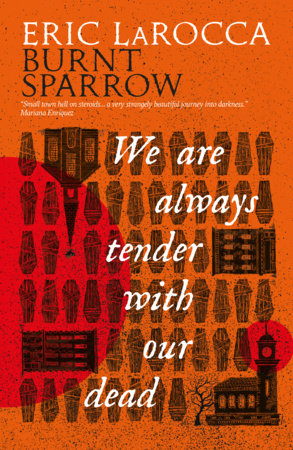
ARC REVIEW: WE ARE ALWAYS TENDER WITH OUR DEAD (BURNT SPARROW, BOOK 1) BY ERIC LAROCCA

Reading

When I love a book, I want to tell it to the world. I will sing its praises to anyone who will listen (and even folks who won’t, as long as they don’t protest too loudly).

Most of the time.

There are, however, books that I love, and I mean really love, that I have to consider carefully before sharing my enthusiasm. Why? Glad you asked! Some books are extreme enough, transgressive enough, that I have to think twice before making a recommendation. Do I know my fellow reader well enough to suggest a book that for some people would be too much to handle? I’m talking about books like Exquisite Corpse, Tender Is the Flesh, Santa Steps Out, A Feast Unknown, books that I love but which don’t just push the envelope but shred it into confetti.

I’m talking about Eric LaRocca’s books. In a few short years, LaRocca has become a must-read author for me. They’re redefining what horror can be, and they’re doing it in the most uncompromising way possible. Book after book, LaRocca has gleefully served up a big fuck you to horror conventions, and I’m there for it.

They’re forthcoming We Are Always Tender With Our Dead is book one of the Burnt Sparrow trilogy, and it is their biggest, baddest fuck you yet.

Burnt Sparrow is a small New Hampshire town where a brutal, senseless act of mass murder transforms the lives of everyone involved. For a teenage boy named Rupert, the violence forces him to confront a family consumed by trauma and brutality. It forces the rest of the town to test the limits of vengeance, cruelty, and perversion. At what point does retribution cross the line and become just as evil as the event that ignites it?

LaRocca writes with visceral, lyrical intensity. We Are Always Tender With Our Dead is harrowing from first page to last, a portrait of cruelty and overwhelming grief. There are scenes here that will stay with you for a long time. Honestly, LaRocca has outdone themself. For me, this is their best, most fully realized work yet.

One final note…LaRocca has included a heartfelt content warning. Please take it seriously. This book may not be for everyone, but if you like your horror deep, dark, and devastating, with no holds barred, We Are Always Tender With Our Dead is made for you. It releases September 9th, 2025, and is available for preorder now.

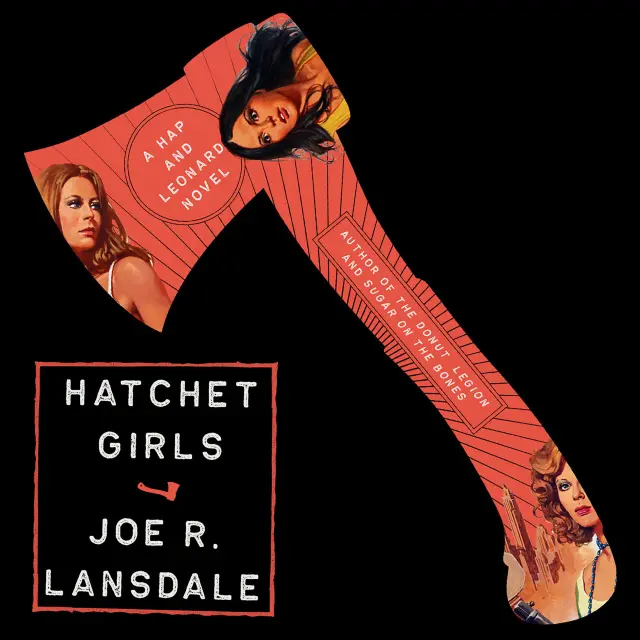
ARC REVIEW: HATCHET GIRLS BY JOE R. LANSDALE

Reading

I’m just gonna say it—Joe Lansdale is a national treasure who should be talked about in the same breath as American writers like Twain, Steinbeck, and Faulkner. His novels and short stories, most set in East Texas, confront violence, racism, and poverty in language that can be both lyrical and downright ugly, sometimes in the same sentence. And unlike those other fellas (Twain excepted) he’s often howlingly funny. He’s also a better dialogue writer than any of them.

I love all of Lansdale’s work, but the Hap and Leonard books are my absolute favorites. After all this time—the first, Savage Season, was published in 1990—Hap Collins and Leonard Pine have grown into complex, fully realized characters. Lansdale has done something downright profound with the many novels and short stories that make up their history. He’s let them age. In the new novel, Hatchet Girls, Both Hap and Leonard are feeling the years, feeling their own approaching mortality. They aren’t quite as spry as they used to be. Hap especially. Leonard isn’t quite as willing to admit he’s slowed down a step.

Hatchet Girls starts with a murderous, meth-crazed hog, and then things go off the rails. Any Hap and Leonard novel is rife with violence and danger, and Hatchet Girls has plenty of that. There are drug-dealing gangs, and a group of hatchet-wielding young women let by a psychotic woman with a taste for vengeance. Lansdale has a real knack for describing explicit violence that’s very much in evidence here. The action, punctuated by moments of black-as-pitch humor, is non-stop. As the bodies, and assorted body parts, pile up, the danger, to Hap, Leonard, and their loved ones, feels real.

Speaking of loved ones, Brett and Pookie are deeply involved in the story, and their appearance is welcome as always.

A new Hap and Leonard novel is always a cause for celebration. It’s like when good friends who have been away for awhile come back for a visit, ready to make up for lost time, hit the town, get rowdy, and generally fuck shit up.

Hatchet Girls drops August 19, 2025, and is available for pre-sale now.

ARC REVIEW: THE ESSENTIAL HORROR OF JOE R. LANSDALE

Reading

As a reader, Joe Lansdale makes me happy. He somehow writes exactly what I want to read. To paraphrase a recent Stephen King title, I like it darker, and Lansdale always, always delivers.

As a sometimes writer, Joe Lansdale makes me pissed off. Despite how prolific he is—and make no mistake, he’s very prolific—and despite working in a wide variety of genres, including horror, crime, suspense, science fiction, fantasy, and often a mix of any and all of them, his work is always so damn good. He sets unreasonably high expectations for the rest of us. I mean, come on, Joe. Slip up once in a while. Write a shitty sentence.

The Essential Horror of Joe R. Lansdale is, as the title suggests, essential reading for horror fans. This collection is a retrospective of sorts, dipping into every part of Lansdale’s career, including some of his earliest work. While there is plenty of humor here, as there nearly always is with Lansdale, this is a dark, dark, bunch of stories. There are monsters here, of both the supernatural and human variety. Lansdale never looks away from violence, racism, hate, and evil, and he never allows the reader to look away either. In prose honed to a razor sharp edge, he plays all over the horror sandbox, from crime and suspense to southern gothic, science fiction to Lovecraftian horror.

If you’re a Lansdale fan, as I am, you’ll find many of your old, bloody favorites here. Mine include:
• God of the Razor
• Tight Little Stitches in a Dead Man’s Back
• On the Far Side of the Cadillac Desert with Dead Folk
• The Bleeding Shadow
• Bubba Ho-tep
• Night They Missed the Horror Show

Honestly, I could have made it easier and listed all the stories. Lansdale is a national treasure.

The Essential Horror of Joe R. Lansdale will be published October 7, 2025, and is available for pre-order now. If you’re easily frightened, or easily offended, this might not be your cup of tea. Otherwise, don’t miss this one.

BOOK REVIEW: THE QUEEN BY NICK CUTTER

Reading

Horror is a big, beautiful genre with a sub-genre for every type of reader—slasher, gothic, psychological, supernatural, folk, the list goes on and on—and I like them all, but one of my personal favorites is body horror. There a select few authors who are capable of doing things to the human body on the printed page that can make you set the book down, back away slowly, and go for a long walk.

One of the very best when it comes to crafting body horror is Nick Cutter, the pseudonym literary fiction writer Craig Davidson uses when writing horror. His novel The Troop is a masterclass, a stomach-churning, virtuoso performance that makes you read things your brain absolutely does not want to process.

Late last year, Cutter released The Queen, and it just might equal The Troop in balls-to-the-wall, gonzo, body horror mind-fuckery.

Margaret’s lifelong best friend Charity disappeared over a month ago after a traumatic event, and the missing persons case has gone cold. That is, until the morning Margaret discovers a new iPhone on her doorstep, with a text message from Charity. What begins as a harrowing scavenger hunt, a cat-and-mouse game with deadly consequences, reveals secrets that have been long buried.

Cutter tells this story over the course of just one day, and it’s a bravura performance, ratcheting up tension to an almost unbearable degree. At this point you may be asking yourself, hey Dave, sounds great, but where does the body horror come in? Here’s the thing…I’m not telling. I had to learn it for myself, and so do you. Suffice to say that it involves insects, and you may never look at those little creepy crawlies the same way again.

As long as you have the stomach for it, literally, The Queen is a helluva ride. I loved every minute of it.

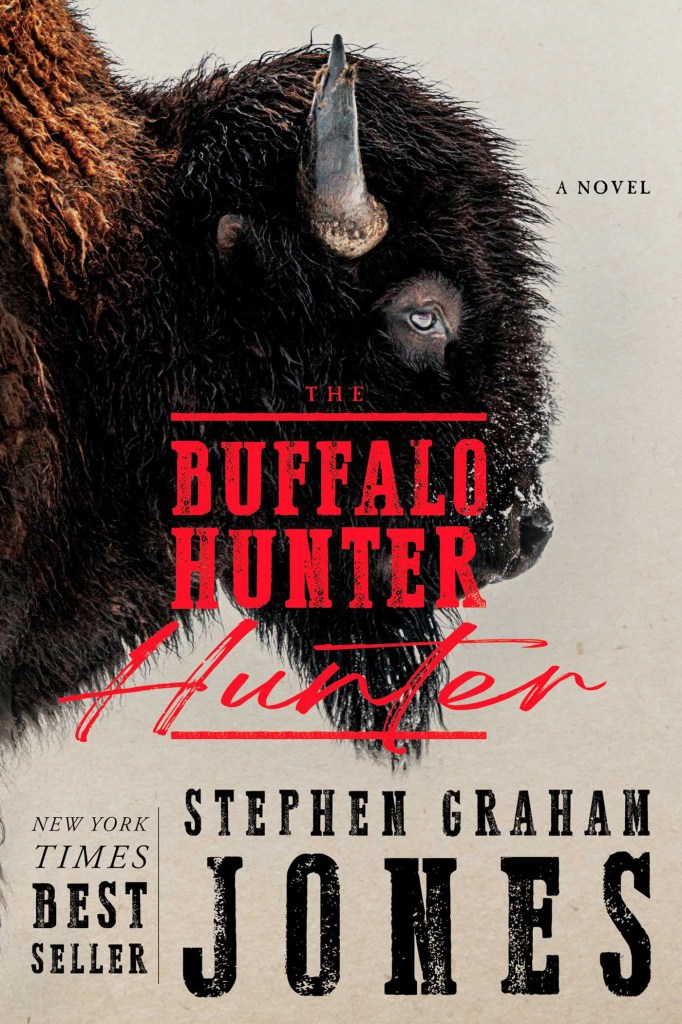
BOOK REVIEW: THE BUFFALO HUNTER HUNTER BY STEPHEN GRAHAM JONES

Reading

I’m not sure how it’s even possible, but Stephen Graham Jones keeps getting better. The Buffalo Hunter Hunter is a master class in bravura storytelling by an author truly at the top of his game. As much as I love the Indian Lake trilogy and many of his other novels (I’m looking at you, Mongrels), I’ve always considered The Only Good Indians his best work. The Buffalo Hunter Hunter might, maybe, be even better.

This is a story within a story within a story. A young academic named Etsy Beaucarne discovers the diary of her great, great grandfather, Arthur Beaucarne, a Lutheran pastor, written in 1912. Within those brittle pages, he recounts a series of conversations—confessions would be more accurate—with a Blackfeet named Good Stab. Drenched in blood, history, and sorrow, the story of Good Stab’s life, and Arthur’s as well, is a triumph for Jones. He does something truly remarkable here, giving Etsy, Arthur, and Good Stab their own distinctive, original voices, juggling their stories effortlessly. I say effortlessly, because that’s how it feels as you read it, but I know from Jone’s afterword that it was no easy task.

This is historical horror at its best, at once a dark tale of revenge and a searing indictment of how native Americans were treated by white settlers. Jones uses real life history as a vehicle to carry his story along on waves of unflinching brutality and fever dream intensity.

One more thing…in the last chunk of the novel, when the story returns to Etsy, The Buffalo Hunter Hunter becomes a wild, audacious tour de force. It’s so over the top, so crazy, and yet so perfect an ending that there couldn’t be any other. I salute you, Mr. Jones.

The Buffalo Hunter Hunter is a must read.

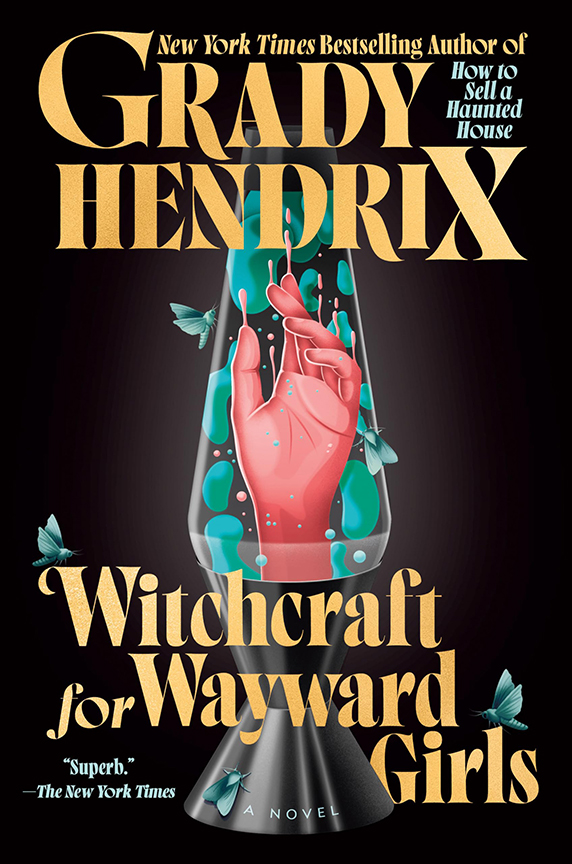
BOOK REVIEW: WITCHCRAFT FOR WAYWARD GIRLS BY GRADY HENDRIX

Reading
Version 1.0.0

I’ve been a fan of Grady Hendrix since Horrorstör, his ingenious novel that somehow combines supernatural horror with an Ikea catalog. I thought, this is an author to watch. Based on his subsequent work, I was right.

Hendrix always writes with fierce originality, heart, humor, and genuine frights. With Witchcraft for Wayward Girls, however, he takes all those attributes and amplifies them with a layer of righteous indignation at the historical brutality that forms the basis of his story. This is, to my mind, his most humane, deeply felt, and downright best novel to date, and that’s saying something.

Beginning just after World War II, and continuing until the passage of Roe vs. Wade, unwed teenage girls were sent to secret homes to have their babies in shame, and then were coerced into giving the babies up for adoption. The girls were forced to live controlled, regimented lives, told constantly that they were loose, wayward, unworthy of love, even if the pregnancy was the result of rape.

When fifteen-year-old Fern (not her real name—the girls are forbidden from using their real names) arrives at Wellwood House in St. Augustine, Florida, in 1970, she’s a tangled mess of shame and guilt. She just wants to have the baby and forget it ever happened. The girls she meets their—Zinnia, who’s convinced her baby daddy loves her, Rose, a fledgling hippy, Holly, most heartbreaking of all, just turned fourteen, and many others—alter her worldview in profound ways. They fight and argue, but they also support and lift each other up.

Together, the girls try, in subtle and not so subtle ways, to rebel against the adults in charge, to remind themselves that they have worth, but it’s an uphill battle. And then a visiting bookmobile librarian hands Fern a book on witchcraft. Desperate for agency, for a way to take control over their lives, Fern and her small circle begin to dabble in the occult.

Hoping for a little power against their oppressors, they soon realize they’ve unleashed something far bigger, and far more dangerous.

Witchcraft for Wayward Girls reminded me, in important ways, of one of my favorite reads of the last several years, The Reformatory, by Tananarive Due. Like that novel, Witchcraft for Wayward Girls takes as a jumping off point a shameful part of America’s past and imbues it with a supernatural twist. And also like that novel, much of the evil in Witchcraft for Wayward Girls is committed by human monsters.

ARC REVIEW: PUPPET’S BANQUET BY VALKYRIE LOUGHCREWE

Reading

Puppet’s Banquet is a howling, discordant mind-fuck of a novella. Valkyrie Loughcrewe is a rare talent, and this is writing as raw as flayed skin, as ornately decadent as a bad acid trip you can’t escape from, as repulsive as a dumpster filled with spoiled meat roasting in the sun.

I mean all of those descriptives as good things.

The bare bones of the plot—a married couple on a drive through the countryside are attacked, setting into motion a series of catastrophic events for both of them—doesn’t begin to describe the insanity contained within this slim volume. Martin’s body is torn apart and monstrously reassembled, spliced together with the body of a woman, and he is now pregnant. Celia’s mind is shattered in two, with one version of herself tenuously hanging on to the real world, and the other lost in a vortex of madness, chaos, and despair.

The two of them reunite in what seems to be a hospital for rare and unusual maladies. That’s when things get really weird.

This is the first work I’ve read by Loughcrewe, and I thoroughly enjoyed it. I sometimes found myself snort laughing at their audacity, at their willingness to go places few authors would dare to follow. Puppet’s Banquet is gory, disgusting, overflowing with shocking imagery that will fry your eyeballs, and absolutely essential reading if you prefer your horror on the extreme side. Tenebrous Press, the publisher, has a real knack for putting out work that challenges the reader, and rewards them for accepting that challenge.

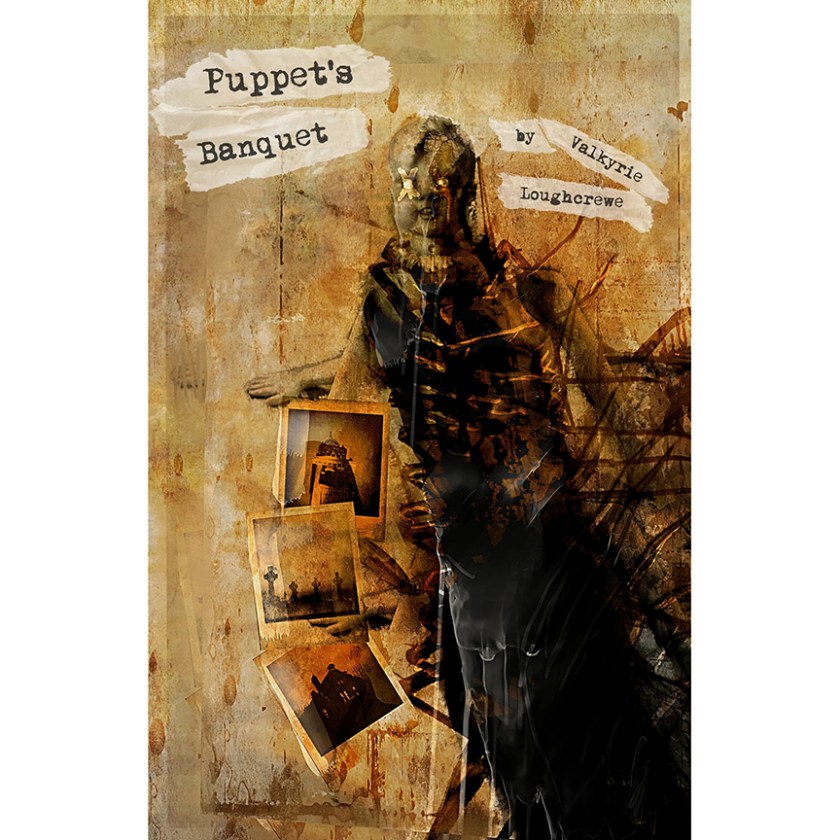
Shout out to the cover artist, Donna A. Black, and the interior illustrator, Trevor Henderson. They both do an excellent job of capturing the dark and twisted feel of the book.

Look for Puppet’s Banquet in May from Tenebrous Press. As long as you have a taste for the morbidly extreme, you won’t be disappointed.

BOOK REVIEW: THE GUNSLINGER BY STEPHEN KING

Reading

Every lover of horror fiction I know can immediately answer this question: What was the first Stephen King book you read? For me, it was a paperback copy of Carrie I found on a spinner rack in my local library (shout out to the Maple Heights, Ohio Public Library). At the time I was 14 and I was reading science fiction and fantasy almost exclusively, but the back cover copy on Carrie hooked me, and from then on I added horror to my genres of choice.

Since then I’ve read nearly everything King has written, with one glaring omission—The Dark Tower series. No good reason for this. Somehow I just never got around to reading them. Then my son, a high school English teacher with similar reading tastes to mine, mentioned that a wonderful podcast we both listen to, Talking Scared, was going to be doing a reread of the series over the next couple of years. My son decided he was going to join Neil, the podcast host, in the reread, and he challenged me to read The Dark Tower series for the first time.

Challenge accepted.

I’ve just finished the first novel in the series, The Gunslinger. It seems silly to do full reviews of these novels, given how long they’ve been around, so I’m thinking I’ll just share my general thoughts.

I enjoyed The Gunslinger for what it is, an intriguing, novel-length piece of world-building. Roland Deschain, the main character, is a great, mysterious creation—a deadly gunslinger who leaves a trail of bodies as he chases after The Man in Black and seeks the Dark Tower of the series title, a monolithic structure that seems to be a nexus of sorts between all worlds. The landscape Roland travels through during the course of the novel is equally mysterious, and King does an excellent job of grudgingly sharing its secrets. Having finished this first volume, I have more questions than answers, but that’s okay. I’m looking forward to the next novel.

Is this top tier King? Not for me. Apparently this is a fix-up novel, five separate stories stitched together, and at least for me, there are places where the seams show. King has become a much, much better writer in the decades since he wrote this. According to my son, The Dark Tower really hits its stride in volume three, and then just gets better and better. Will I agree with his assessment? I’m looking forward to finding out.

Have you read The Dark Tower? Please share your thoughts. And if not, consider joining me in reading the series over the next couple of years. Think of it as a quest, much like Roland’s quest to reach the Dark Tower.

Book Review: Adrift in Currents Clean and Clear by Seanan McGuire

Reading

I love a good book series, and my two current, ongoing favorites could not be more different.

One is Joe R. Lansdale’s Hap and Leonard books—the violent, profane, and sometimes uproariously funny adventures of two hardass Texas good old boys.

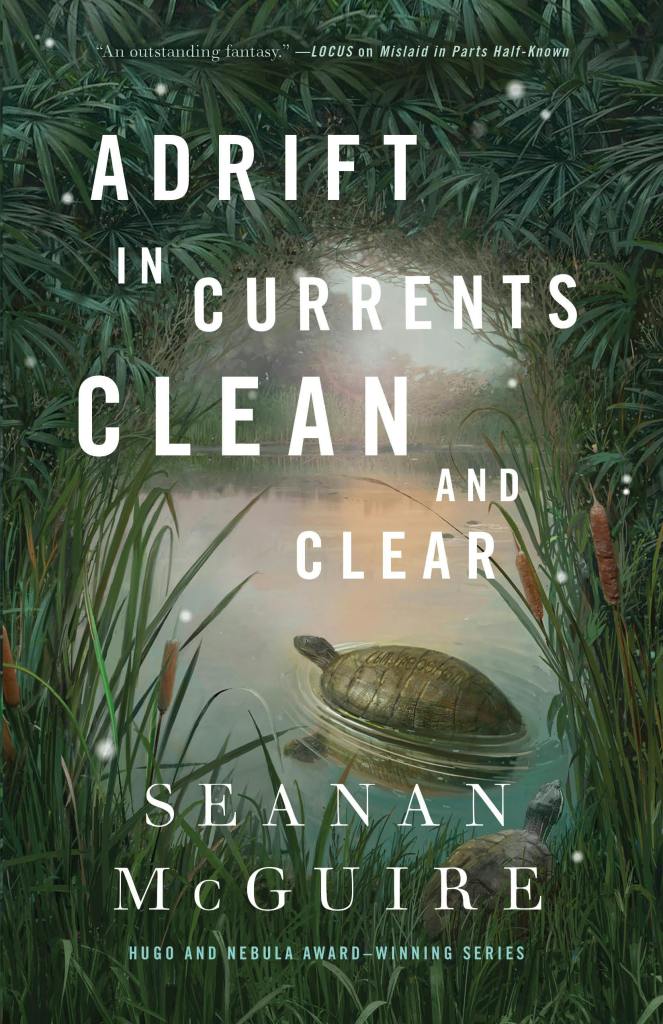
The other, the one I’m here to talk about today, is Seanan McGuire’s Wayward Children books. This series, about what happens to the children who are invited to, and choose to, enter portals to other worlds, and then return to our own, began with Every Heart a Doorway. The newest edition, Adrift in Currents Clean and Clear, is book 10 in the series, and like all the others, it’s breathtaking in its world building, in the lyrical beauty of its language, in the strength of its characters, and in the satisfying delights of its storytelling. These are slim volumes, and yet somehow McGuire packs so much into each that it’s a small miracle.

Nadya is a ten-year-old orphan from Russia born with one arm. While she’s never really seen that as a handicap—it’s hard to miss what you’ve never had—her adoptive parents in Colorado insist on fitting her with a prosthetic arm. Her new family has given her a life she could never dream about in Russia, but Nadya finds herself feeling alone, misunderstood, unloved. The only place she finds peace, the only place she feels a sense of belonging, is a turtle pond near her home. When something that looks very much like a door opens at the edge of the pond, she accepts the invitation and enters.

Nadya finds herself in Belyrreka, the Land Beneath the Lake, a place where water has different weights, where she—one of the Drowned Girls—can still breath. In this wondrous world of fishing boats that ride on the backs of giant turtles, she finds love and acceptance. She finds family. Belyrreka isn’t a paradise. Life can be hard, and there are dangers aplenty. But Nadya has never been one to shy away from a fight or to take the easy way out, and as she grows into a young woman she finds a rewarding place all her own, a place to call home.

As always, McGuire’s world building is exquisite and all-encompassing. Nadya and her new family are wonderfully realized characters.

McGuire is always good, but her work here is flat out dazzling. I hope she never tires of writing about the Wayward Children.

BOOK REVIEW: YOU LIKE IT DARKER BY STEPHEN KING

Reading

First, a confession…I took some time off from reading in the second half of December, 2024. That was probably the longest break I’ve taken from reading since Army basic training in 1980, and was very out of character for me. Reading is my safe place, my security blanket, the way I center myself. As a rule, not reading for me is like not breathing.

But December found me overwhelmed by a combination of things—mostly family and work obligations, and the coming hellscape of the next four years. I felt out of sorts, even hopeless, and for once reading did not give me solace.

Something had to be done. As the new year dawned I turned to an author I first discovered when I was 14 and have happily read ever since, an author who has rarely disappointed me.

It worked. You Like It Darker by Stephen King sucked me in from the first story, and by the end I was already looking forward to the next book I would read with enthusiasm. As dark as these stories are—and they are, the title doesn’t lie—they gave me hope back.

I realize this isn’t much of a book review so far, so…You Like It Darker is a vintage Stephen King short story collection, immensely satisfying. The stories are a nice mix of short, sharp shots to the solar plexus and longer, more involved tales. There’s something for everyone here, and your mileage may differ, but these are my favorites:

Two Talented Bastids: Starts the collection out on a high note, with the tale of two elderly, talented artists, and the secret way they both got that way.

The Fifth Step: A short, nasty little piece of work. Felt a little Joe Lansdaleish to me, which is high praise.

Danny Coughlin’s Bad Dream: The first of the three longest stories in the collection, and quite simply one of the best things King has written. When Danny Coughlin has a possibly psychic dream, he tries to do the right thing, and as the saying goes, the road to hell…

Rattlesnakes: Another long story, the centerpiece of the volume, is a masterful and sometimes chilling meditation on grief. It’s also a sequel of sorts to Cujo.

On Slide Inn Road: A family on a collision course with bad men, and what they’re willing to do to survive.

The Answer Man: This long story closes out the collection, and makes it clear that King is still working at the height of his powers. The life story of one man, and three encounters that change the course of that life. Or do they?

Those are my favorites, but you may have completely different ones. Like I said, there’s something here for everyone. It’s been said plenty of times before, but King is a national treasure.

To end on a personal note: Thanks, Mr. King, for giving me the joy of reading back. I missed it.

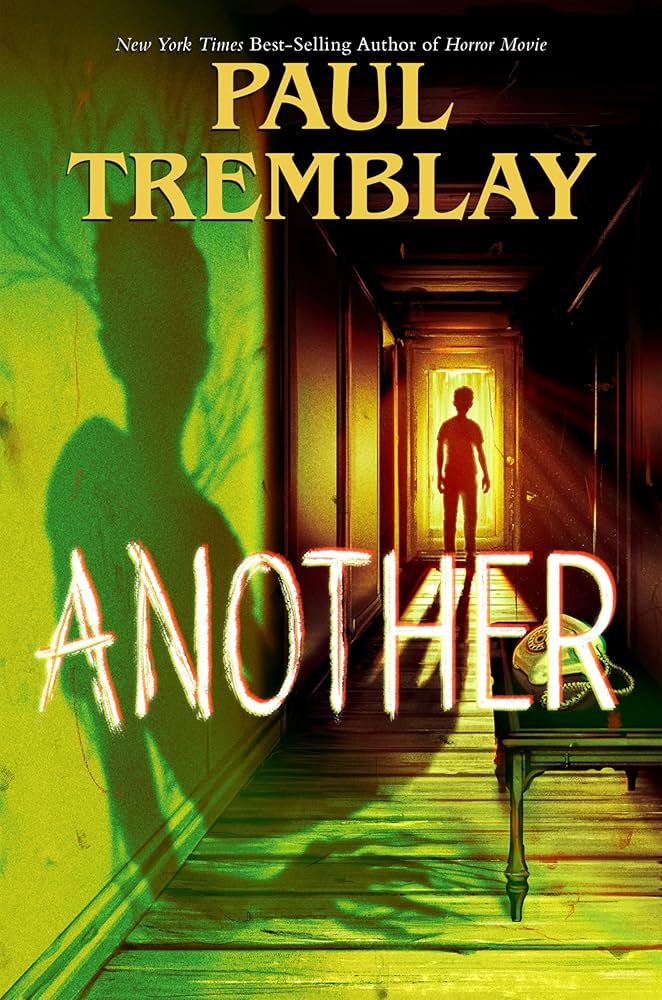
ARC REVIEW: ANOTHER BY PAUL TREMBLAY

Reading

What do you do when you find out one of your favorite horror writers has written a middle-grade novel? You read it, of course!

Another is Paul Tremblay’s first foray into middle-grade fiction, and it should come as no surprise if you’re a fan of his work (and if you’re not, why the hell not?), he knocks it out of the park. With no explicit violence, no rough language, Tremblay has managed to craft a piece of work that’s deeply creepy and unsettling. I mean it, it’s, to be not-at-all-middle-schoolish about it, kinda sorta fucked up.

Casey suffers from facial tics and anxiety, heightened by an unfortunate Zoom event during Covid that made him a school laughing stock, plus his much-loved older sister has gone off to college, leaving him at home with his parents. Then a “friend” named Morel that Casey doesn’t actually know is dropped off for an extended sleepover by a mysterious man. Morel is truly strange and off-putting—he looks like a mannequin made of clay, and can’t speak—but Casey’s parents quickly take to him. Casey forms a tentative friendship with Morel, but eventually realizes that something is deeply wrong with him, something sinister. His parents may be oblivious to his growing unease at the grim reality, or unreality, enveloping their home, but Casey is terrified by the changes happening.

What follows is a masterclass in how to create horror and unease while still staying faithful to a middle-grade aesthetic. Tremblay is continually pushing the envelope when it comes to horror, and I’ll happily follow his work wherever he takes it.

Another will be released July 28, 2025, and is available for pre-order now.

ARC REVIEW: THE BONES BENEATH MY SKIN BY TJ KLUNE

Reading

Many folks seem to have discovered TJ Klune with his novel The House In the Cerulean Sea. I haven’t read that one yet, although it is in my TBR stack. As usual I blame all the fabulous authors out there. Too many books, too little time. No, my first experience with Klune’s singular talent was the novel In the Lives of Puppets. Here’s what I said about it in my review:

… it’s in the small strokes, the fine details, that In The Lives of Puppets truly sings. It’s about the importance of found family, and the power of loyalty and love. It’s a tender, sensitive exploration of Ace and LGBTQ representation. Perhaps most surprisingly to me, it’s laugh-out-loud funny. 

If that little snippet doesn’t make it clear, I absolutely loved the novel.

Now comes The Bones Beneath My Skin, a welcome reissue of a novel first published in 2018. This one is once again concerned with found family, loyalty, and love, and if anything it digs deeper—what exactly makes us human, and what are we prepared to do when all hope seems lost. I loved this novel just as much.

Nate Cartwright is estranged from his brother, and his parents have died, leaving him only a dilapidated truck and the remote lake cabin in Oregon his family visited in happier times. When he loses his Washington D.C. journalist job, he retreats to the cabin, hoping for solitude to lick his wounds and do a little bit of soul searching. Instead he finds squatters—An armed man named Alex, and his charge, a strange young girl named Artemis Darth Vader. Neither of them are what they seem.

What follows is a small miracle, a story that starts out strong and gets better and better as it goes. Part road trip, part government conspiracy, part—nope, that’s all I’m telling you, this novel has secrets you should discover for yourself. It’s a heart stopping roller coaster of action, mystery, and emotion, but more than that, much more, The Bones Beneath My Skin introduces three characters that I would gladly follow anywhere. In particular, Artemis Darth Vader is a delightfully unique, original character, full of love and loyalty and more than a little snark. Klune has created someone truly special here.

Klune masterfully combines breathless suspense with large dollops of humor and a tender slow-burn romance. The Bones Beneath My Skin is a wild ride that’s well worth taking. It debuts on February 4th 2025, and is available for pre-order now.

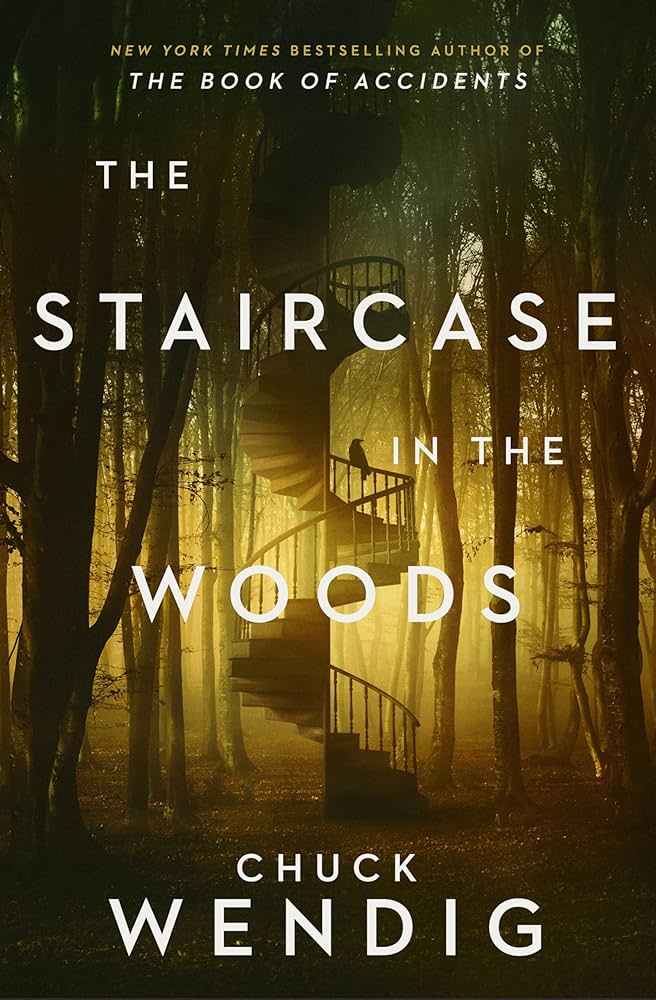
ARC REVIEW: THE STAIRCASE IN THE WOODS BY CHUCK WENDIG

Reading

Here’s the thing: I love coming across unusual, unexpected things when hiking in the woods. Abandoned, overgrown family cemeteries, the crumbling foundation of a ruined building being swallowed by the forest, a child’s rusted tricycle miles from civilization. Once, when hiking off trail in the Beartooth Mountains of Wyoming, I found an elk skull with a red lacquered chopstick poking out of one eye socket.

What’s that have to do with Chuck Wendig’s forthcoming new novel, The Staircase In the Woods? Nothing, and everything. A forest is the perfect place to find mysteries if you’re open to the possibilities. Sometimes those mysteries are harmless fun, oddities to ponder. Sometimes they’re decidedly not.

This is a tricky review to write, because one of the many pleasures of reading this immersive, unsettling novel is discovering its secrets for yourself, and I don’t want to give anything away.

I can give you the basics:

Five teenage friends, a close knit group that call themselves the Covenant, venture into the forest on a camping trip, when a mysterious staircase appears among the trees. One of the group dares to climb that staircase. He disappears, along with the staircase, sending his friends into a spiral of loss and confusion.

Twenty years later the staircase reappears, and the remaining members of the Covenant reunite to search for their long-lost friend.

And…that’s all you get. I will tell you that this is a story about friendship, and what that word means when the stakes escalate to unimaginable heights, how far you’re willing to go to have your friend’s back, even when they might be pushing you away.

Because this is Chuck Wendig, I can promise you that the characters are all complex, fully-realized people that you’ll find yourself rooting for. The plot is as tightly wound as a watch spring, ratcheting up tension with each chapter. The horrors, and they are many and varied, are visceral, even gut wrenching. Chuck Wendig does not fuck around.

Wendig has become one of my favorite writers. Wanderers and Wayward were masterpieces of apocalyptic science fiction, and his recent forays into horror—The Book of Accidents and Black River Orchard—are fresh and exciting additions to the genre. The Staircase In the Woods is a more than worthy addition to his impressive collection of work.

The Staircase In the Woods will be released on April 29, 2025, and is available for pre-order now. Don’t miss this one.
BOOK REVIEW: THE PALEONTOLOGIST BY LUKE DUMAS

Reading

I don’t talk about it much here, but along with books, I’m a huge movie fan. And that makes sense to me, because I think books and movies share some similar characteristics (besides the obvious fact that many movies start off as books). There are books and movies that are gorgeous—words that sing off the page, visual scenes that delight and thrill the eyes. You often find yourself thinking about them days later.

There are books and movies that are—I’ll say it—trashy delights, so bad they’re good. They may be poorly constructed, with gaping plot holes and cardboard characters, but they do not commit the one unforgivable sin in books or movies. They are never boring.

Then there are books and movies that are compulsively readable and watchable, that grab you by the throat and never let go from beginning to end. These are the popcorn movies, the popcorn reads, and I love them. Their prose may not sing, but there is poetry in an expertly constructed plot. The Paleontologist, for me, is the perfect embodiment of a popcorn book—a propulsive, intricately designed plot that revolves around an intriguing central mystery.

I was immediately sold on The Paleontologist by the cover blurb—Night at the Museum if it was written by Stephen King. And it delivers on that promise.

Dr. Simon Nealy, curator of paleontology, returns home to work at the crumbling, gone to seed Natural History Museum where his younger sister disappeared from when they were both children. Her disappearance has haunted him since it happened, as he blames himself. Things quickly go south for Simon—he’s haunted by his past, by memories of his missing sister and his abusive mother, but there are also hauntings in the museum of a more supernatural variety. Dinosaur ghosts? Yes, please. The mystery only deepens as he begins to read the diaries of his disgraced predecessor. Much as the previous curator of paleontology mentally unravelled, Simon is soon spiraling out of control, questioning reality itself.

If you’re in the mood for a fun, compulsively readable thriller of a book, one with familial trauma that gives it a beating, bleeding heart, you can’t do better than The Paleontologist. Give it a read.

BOOK REVIEW: MAEVE FLY BY CJ LEEDE

Reading

What should a reader do when they read an ARC of a brilliant forthcoming novel, one that’s going to blow people’s minds, and you yearn for another read by that author? Glad you asked! In my case, the ARC was American Rapture by CJ Leede (my, sorry, rapturous review here: https://davewritesanddraws.com/2024/07/30/arc-review-american-rapture-by-cj-leede/). Since I’m a sensible fella, I decided it was time to read Leede’s first novel, Maeve Fly. I’m happy to report that American Rapture is no accident, because Maeve Fly is a brutal, no-holds-barred masterpiece.

Maeve, the title character of the novel, is an utterly original creation. By day she works at the happiest place on earth, a barely disguised Disneyland, a place and job she unequivocally loves despite the black heart that beats inside her chest. At night, when she’s not tending to the gravely ill grandmother she lives with, a once famous actress, she prowls the seedier corners of the Sunset Strip, sometimes accompanied by her best friend. She’s found happiness, of a misanthropic sort, even if she sometimes struggles with keeping her darker urges, the wolf that lives inside her, contained. Then her best friend’s brother moves to town, setting off a blood-soaked, murderous chain of events that, once started, accelerates like a runaway train to the very end of the novel.

Maeve Fly is a poisonous love-letter to Los Angeles, a city Leede either loves or hates, possibly both. Once unleashed by circumstances, Maeve moves like an unrepentant Patrick Bateman through LA in an orgy of violence and depravity that’s at once shocking, thrilling, and, at least for me, ultimately cathartic (which might say something about me I’d rather not contemplate, but I digress).

This is bold storytelling, as beautiful as it is terrifying. If you have the stomach for it, if you like your horror uncompromising, this is a must read. I should also mention that, depending on how dark your sense of humor is, it’s often hilarious. I read most of Maeve Fly on a plane, and I found myself snorting out loud with alarming frequency.

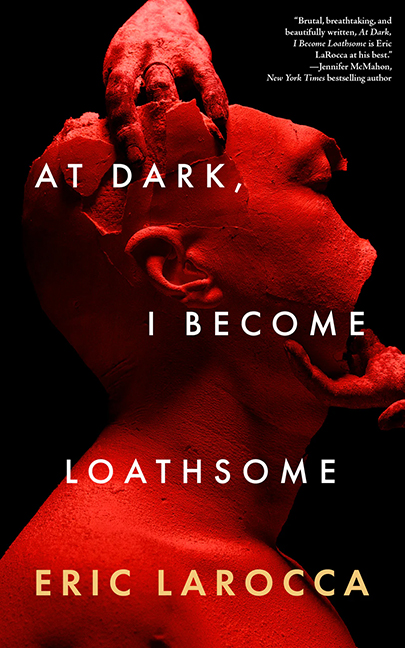
ARC REVIEW: AT DARK, I BECOME LOATHSOME BY ERIC LAROCCA

Reading

Funny thing I’ve noticed. Each time I review a book by Eric LaRocca, I tend to start off with the same statement: Eric LaRocca does not fuck around.

Does this hold true for At Dark, I Become Loathsome? Like you wouldn’t believe.

Ashley Lutin, the main character at the dark heart of this novella, is wallowing in hopelessness, despair, and depravity. He’s lost his wife to cancer, and his young boy has been taken. The only thing that keeps him from ending his own life is the service he provides for others who are similarly at the end of their rope, a extreme ritual or sorts. Then he meets another man who matches him, depravity for depravity.

Lutin is a complex, polarizing character, fascinating but deeply unlikeable. Throughout the book he repeats the title, At Dark, I Become Loathsome, like a poisonous mantra, almost a mission statement.

LaRocca excels at pushing the envelope, at creating situations and characters that are so beyond the pale you’re not sure what you’re reading, but you also can’t stop. Reading LaRocca’s work, I get the same feeling I got when I first read books like Exquisite Corpse, The Girl Next Door, and Tender Is the Flesh—books that challenge a reader’s beliefs on every level.

At Dark, I Become Loathsome is a slim volume, but it is one heavy book.

If you like your horror uncompromising, if you’re ready and willing to dive into the deep, shadowy end of the fiction pool, the place where monsters human and otherwise live, At Dark, I Become Loathsome is the perfect book for you. It releases January 28th, 2025, and is available for pre-order now.

ARC REVIEW: TRVE CVLT: a Tenebrous Gamebook BY Michael Bettendorf

Reading

Look, here’s the thing: Nothing about Trve Cvlt should work, and yet it does, beautifully. Here’s what I mean.

First, it’s written in second person, with “you” as the main character. Writing an entire novel in second person is a highwire act that’s tricky to navigate, and trickier to pull off successfully, but Bettendorf does a great job. Instead of being off-putting, Trve Cvlt pulls you in, making you an intimate part of the story without ever feeling like a gimmick.

Second, and if you’re a gamer you may have already guessed this from the sub-title, Trve Cvlt is a choose your own adventure story. Remember those from when you were a kid? The novel doesn’t overdue it, it’s not every chapter, but it adds a quirky little spin to the story. In fact, part of me wants to go back and make different decisions, just to see what I missed.

Last is the story itself. Trve Cvlt starts off as a gritty, knowing look at a young midwest black metal band with all the infighting, backstabbing and love of music that entails. And then…and then the madness starts. Bettendorf throws a legendary, possibly haunted cult house, a cult, a preacher and his wife who maybe aren’t what they seem (“your” parents, by the way), otherworldly, cosmic horror, and a hard right turn into murder and mayhem, throws it all into a blender, and hits puree. Again, it shouldn’t work, but it does. This is a fast, fun read.

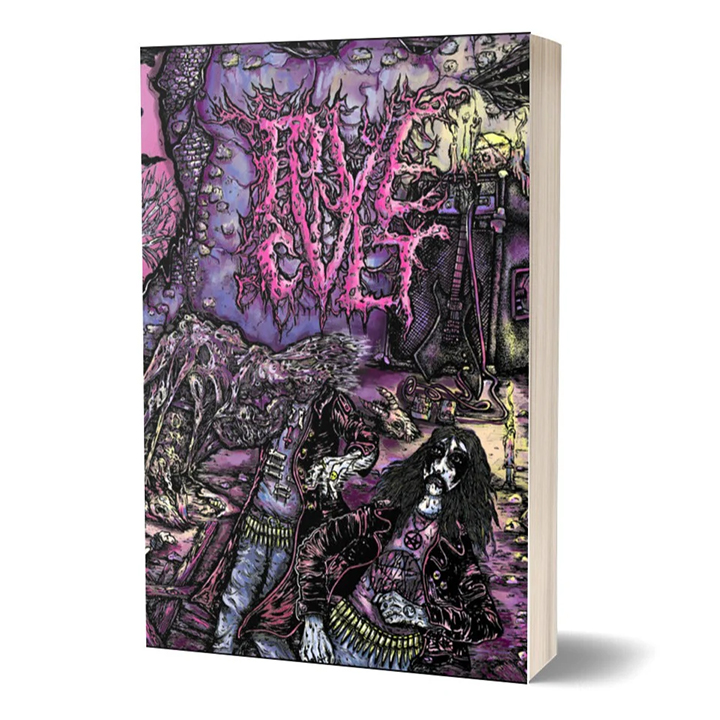
I also want to mention the cover art by Echo Echo. It’s densely, hypnotically detailed, and fits the novel perfectly.

Trve Cvlt debuts September 25th, and is available for pre-order now. I think this is the third book from Tenebrous Press I’ve read, and I’ve enjoyed them all. They are definitely a publishing house to watch.

BOOK REVIEW: PAPERBACKS FROM HELL BY GRADY HENDRIX

Reading

You know how some books are just made for you? How you don’t so much read them as happily tumble into their pages? Paperbacks from Hell by Grady Hendrix was like that for me. It’s a meticulously, joyously researched celebration of paperback horror from the 70s and 80s. I spent my teens in the 70s and my twenties in the 80s, fully immersed in horror, science fiction, and fantasy. This book is pure, unadulterated nostalgia for me, and I loved every minute of it.

I’m a huge fan of Hendrix’s fiction, and it turns out he’s just as good at non-fiction. Paperbacks from Hell brings a telling eye for detail and historical perspective to the books that made this time period such an important one for horror. His words have the ring of authenticity.

But for me, that’s not the best reason to pick up Paperbacks from Hell. Hendrix fills it front to back with glorious, high res, full color examples of the cover art that graced these books. I remember so many of them—I read them, I sold them as a sales associate at Waldenbooks, I collected them—and seeing them all here again was like coming home.

If you’re a fan of horror in general, horror of this time period in particular, or just gonzo, balls-to-the-wall, book cover art, Paperbacks from Hell is a helluva ride. Thank you, Mr. Hendrix, for the exciting trip down memory lane.

BOOK REVIEW: SUGAR ON THE BONES BY JOE R. LANSDALE

Reading
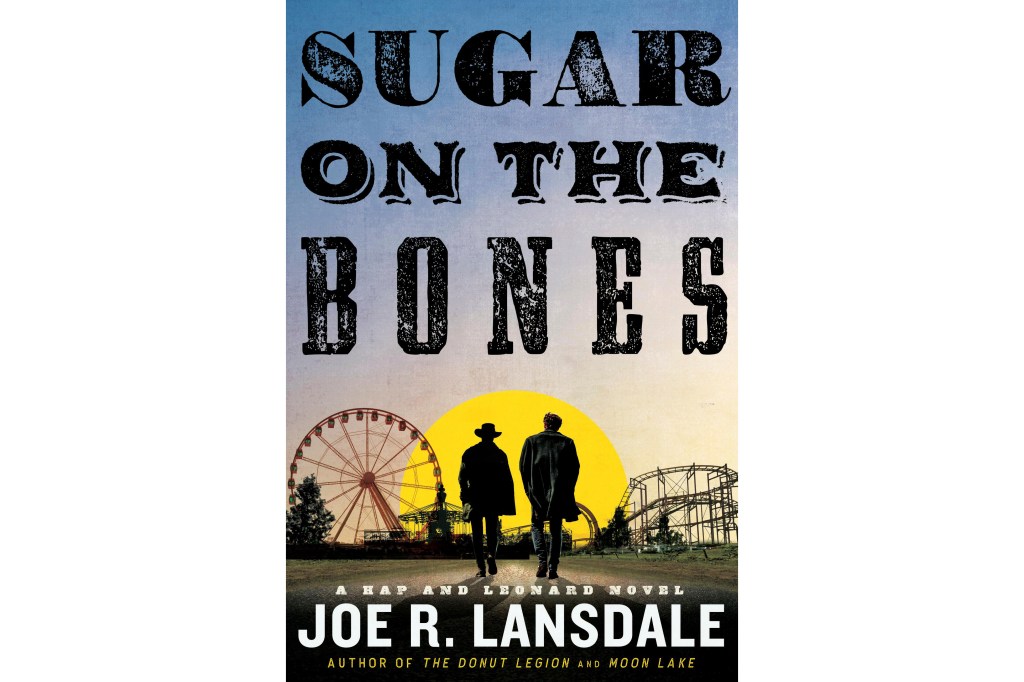
This image released by Mulholland Books shows “Sugar on the Bones” by Joe R. Lansdale. (Mulholland Books via AP)

A new Hap and Leonard novel is always cause for celebration, and not surprisingly, Sugar On the Bones does not disappoint. I’m a big fan of book series—they give you a chance to get to know the continuing characters in a way that a single novel often doesn’t, and not just the main characters. Sugar On the Bones brings back several folks from earlier books, and the fact that you know them, know their backstory, makes the novel an even richer, more satisfying read. There’s a shared history here, not just between the boys and these characters, but between all of them and we readers.

Another thing I love that Lansdale has done over the course of the past few Hap and Leonard books is to let them age—I was going to say age gracefully, but come on, that would be stretching the truth to the breaking point—but they are aging. In Sugar On the Bones, Hap and Leonard are still shit-talkers and shit-kickers, but are at least feeling their mortality. I think a big part of it is that they both now have folks they love to live for. They’re still fearless, still willing to go headlong into the fire instead of away from it, but they at least think about the consequences of their actions. Do they still do stupid, dangerous shit? Absolutely. They wouldn’t be Hap and Leonard otherwise. Part of the fun is watching them consider the odds, then still say damn those consequences.

I don’t really want to dig too deep into the plot—as usual, Lansdale is a consummate storyteller, an unmatched spinner of yarns. This one starts out with a potential missing persons case that quickly turns deadly, with an East Texas crime syndicate out for blood. Also as usual, there are a whole book full of oddball characters that add to both the fun and the danger. Sugar On the Bones is fast paced and violent, with a final set piece that will start your heart rate spiking and keep it there.

Lansdale is working at the top of his game here, with a perfect mix of lovingly described mayhem, lyrical description, glorious turns of phrase, and the best dialogue writing of any author working today. In fact, I’m going to make a bold statement here—I think Lansdale is now a better dialogue writer than Elmore Leonard.

Sugar On the Bones is more fun that a couch full of mice (you have to read the book), and I hope Lansdale keeps writing Hap and Leonard books for years to come. If the boys end up sitting next to each other in rocking chairs on Hap’s front porch, blankets on their laps, solving whatever crimes happen to pass them by, I’m fine with that. Hell, they don’t even have to solve crimes. Just keep shit-talking.

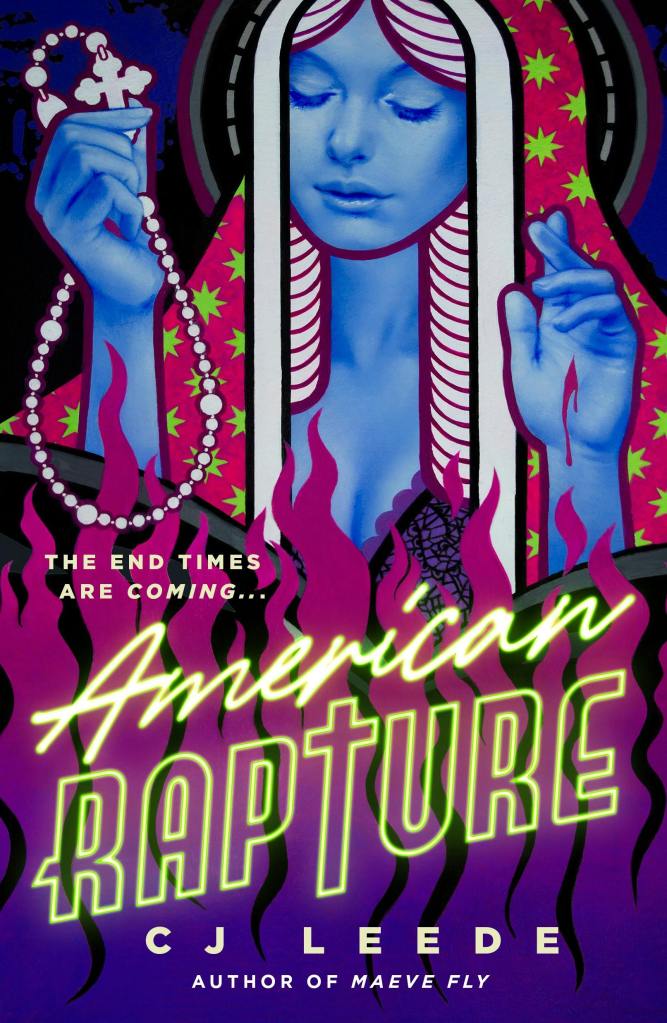
ARC REVIEW: AMERICAN RAPTURE BY CJ LEEDE

Reading

CJ Leede’s first novel, Maeve Fly, set off a series of seismic shocks in the online circles where I hang out, yet I haven’t managed to read it yet. I have no good excuses, except for the usual so many books, so little time. It’s been on my towering TBR pile for quite a while, and after reading American Rapture, Leede’s forthcoming second novel, I’m moving it way up the stack, because people, you are not ready for this one.

Sophie, the heart of American Rapture, is a teenage girl raised in a painfully repressive Catholic household, a place where paintings of Jesus and crosses hang on every wall, where guilt and sin, shame and repression, heaven and hell, are spoon fed to her on a daily basis. Separated from her twin brother, for the most part closed off from everything outside her home and church, the very insular world she inhabits, Sophie is sad, lonely, wracked with the feeling she’s not worthy of love.

That situation quickly unravels when a mutating virus that turns victims into sex-crazed zombies spreads like a wildfire across the the US, setting Sophie on a brutal, gut wrenching journey in search of her brother and safety. Sophie soon finds herself questioning everything she knows, and discovering everything she doesn’t know, as she fights for survival. Along the way she gathers a found family of sorts, a desperate group of fellow survivors, including the best fictional dog I’ve read in a long time.

I love a good found family story, and American Rapture does not disappoint in that regard. As the ragtag group traverses a midwest hellscape, I found myself cheering for their brief successes, and mourning their losses. Make no mistake, this is very much an apocalyptic novel—think The Road mixed with zombies, with a healthy, sinister dose of religious fundamentalism mixed in. It is harrowing and unsettling, filled with uncompromising violence.

Sophie is a wonderful heroine, brave and terrified, innocent and flawed. When she finds all the notions that have been drilled into her by her parents and her church—things like love, sex, virginity, a woman’s place, blind faith in God—challenged by the maelstrom she finds herself in, she allows herself to confront those challenges head on. All the characters, Sophie especially, are heartfelt creations. Leede writes with heartfelt empathy.

A lot of American Rapture hits uncomfortably close to home, given our current political/social climate. There were moments here when I found myself reading through tears. Tears for what the characters are experiencing, and tears of rage at how truly inhumane humans can be. This is visceral horror at its finest, horror that isn’t afraid to ask profound questions.

American Rapture releases October 15, 2024. Don’t miss this one.

AUDIOBOOK REVIEW: THE BABYSITTER LIVES BY STEPHEN GRAHAM JONES, READ BY ISABELLA STAR LABLANC

Reading

Here’s the thing…I’ve resisted the idea of audiobooks for a long time. Not because I don’t believe it’s the same as reading—any method of cramming good words into brainmeat is okay by me—but because the one time I tried it several years ago, I failed miserably. Maybe it was the book I chose, maybe my frame of mind at the time, but I just couldn’t keep the story in my head. Still, I always told myself I should try again.

Then last week I had a roadtrip, and I decided to dip my toe in the audiobook waters again. I did a quick search and found the perfect thing, a book only available on audio by one of my favorite authors—The Babysitter Lives by Stephen Graham Jones.

Such a good choice!

Charlotte is a babysitter, a great one (except for one near-disaster she tries not to think about), with what should be an easy gig—babysitting six-year-old twins for new clients. Feed them, put them to bed, and spend the evening studying for the SAT test the next day.

The house has other plans.

Yes, this is a haunted house novel, but unlike any I have read before. Jones starts with the idea of other realities, funny places in the words of the twins, and goes buck-fucking-wild. Once the madness begins he never lets up on the gas, ratcheting up the tension, throwing in so many twists and turns it will make you dizzy, but never losing the thread of the story. Jones is never less than a compelling storyteller, and he’s operating at peak efficiency here. There are Inception-level layers and intricacies to The Babysitter Lives, so many balls being juggled, but Jones doesn’t drop a single one. I should also mention that this novel is deeply creepy, with scenes that have stayed with me.

Charlotte is a wonderful character—brave and resourceful in the face of overwhelming terror, tender and protective of the twins, and of her girlfriend Murphy when she shows up unexpectedly. She never gives up hope, even when things seem hopeless.

Isabella Star LaBlanc, the narrator of the book, has her hands full with this Chinese puzzle box/Russian nesting doll of a story, and she knocks it out of the park. She imbues Charlotte with every bit of intelligence and emotion that Jones gives her on the page. It’s a remarkable performance.

Give The Babysitter Lives a listen, and be both frightened and entertained. Myself, I’m looking forward to my next roadtrip, and my next audiobook.

ARC REVIEW: IN THE MAD MOUNTAINS—STORIES INSPIRED BY H.P. LOVECRAFT, BY JOE R. LANSDALE

Reading

What do you think of when you hear something’s been inspired by H.P. Lovecraft? For me it’s mysterious, cosmic, monolithic, even god-like horrors—horrors that are often hard to describe, but that’s part of what makes it Lovecraftian. As a rule, there are tentacles involved.

There are a lot of authors who play in Lovecraft’s sandbox—minus the virulent, unacceptable racism—to greater and lesser success. The very best of them, such as Matt Ruff with Lovecraft Country, put their own unique spin on the eldritch horrors.

It should come as no surprise that Joe R. Lansdale’s take on Lovecraft is utterly original—Scary, fun, and cosmic as all hell. Lansdale is a master in just about every genre imaginable (not sure if he’s ever tried his hand at children’s books, but that could be interesting), and it shows here. The eight stories dip into several genres, sometimes more than one at once, and it pays off big time. Every story is a home run, but here are my favorites:

The Bleeding Shadow—Blues music as a vehicle for opening a door to another, terrifying dimension…a door that can’t be closed.

Dread Island—An all-out gonzo masterpiece that somehow throws Tom Sawyer, Huck Finn, characters from the Uncle Remus, a mysterious island in the middle of the Mississippi, and unknowable cosmic horror into a blender and hits puree.

The Crawling Sky—This grim, somber story transplants Lovecraftian horror to the old west, with terrifying results.

In the Mad Mountains—The title story in this collection is easily one of my favorites things Lansdale has ever written. Set in a forbidding arctic landscape, the horrors of “In the Mad Mountains” just keep coming. A bravura performance.

These are my personal favorite stories, but they’re all excellent. Lansdale is a national treasure.

In the Mad Mountains debuts October 15th, and is available for pre-order now.

ARC REVIEW—FEARS: TALES OF PSYCHOLOGICAL HORROR, EDITED BY ELLEN DATLOW

Reading

There are a lot of great editors that play in the science fiction, fantasy, and horror sandbox. But are any of them as consistently brilliant at crafting genre anthologies, as consistently brilliant at attracting the very best authors and building drool-worthy tables of contents, as Ellen Datlow? No. She’s the very best, as Fears: Tales of Psychological Horror amply demonstrates.

When it comes to Fears: Tales of Psychological Horror, you should definitely take the word Horror in the title seriously, because these stories are one gut-punch after another. There’s not a supernatural entity to be found here, just human being inflicting violence, terror, and depravity upon each other. Some are over the top in the horrors they display, and some are quiet, subtle shockers—both types of stories are equally disquieting, equally disturbing. When it came to choosing the contents of this book, Datlow did not fuck around.

While every story in the anthology has something to recommend it, here are a few that were standouts to me, and your favorites may be totally different than mine. Most of the stories were new to me, but the two I had read before happened to be two of my favorites, so let’s start with those.
Singing My Sister Down by Margo Lanagan—This brilliant piece of anthropological fantasy was my introduction to the extraordinary Lanagan, and it’s a shattering study of a family caught in a cultural trap they cannot escape. I’ve read this story half a dozen times, and I get something new from it every time.
Where Are You Going, Where Have You Been? by Joyce Carole Oates—You’ve probably read this at one time or another, it’s one of the most taught, most anthologized stories in history. It still packs as much punch as it did when it was published in the sixties. A chilling study in power dynamics coercion.

Bait by Simon Bestwick—The first story in the collection, about a young woman who’s not what she seems, it lets you know exactly what you’re in for.

A Sunny Disposition by Josh Malerman—Old, frail Grandpa Ray gives his young grandson a peek behind a very dark curtain.

Back Seat by Bracken MacLeod—I said above that every story here is a gut-punch…this one made me put the book down and go for a walk. Crushingly sad and hopeless.

One of These Nights by Livia Llewellyn—Two teenage girls and a public swimming pool in the summer are the ingredients for this twisted little tale.

Cavity by Theresa Delucci—The life of one woman connected, in one way or another, to thirty-six murderers. Told in cold, clinical, matter-of-fact detail that makes it shockingly powerful.

Unkindly Girls by Hailey Piper—What happens when you discover a devastating family secret? What do you do?

Teeth by Stephen Graham Jones—Hard-boiled crime fiction shot through with a queasy kind of horror, proof that Jones should maybe write more crime fiction.

Those are my favorites, but as I said, there’s not a clunker in the bunch. Fears: Tales of Psychological Horror releases September 10th, and is available for pre-order now. Don’t miss this one.