

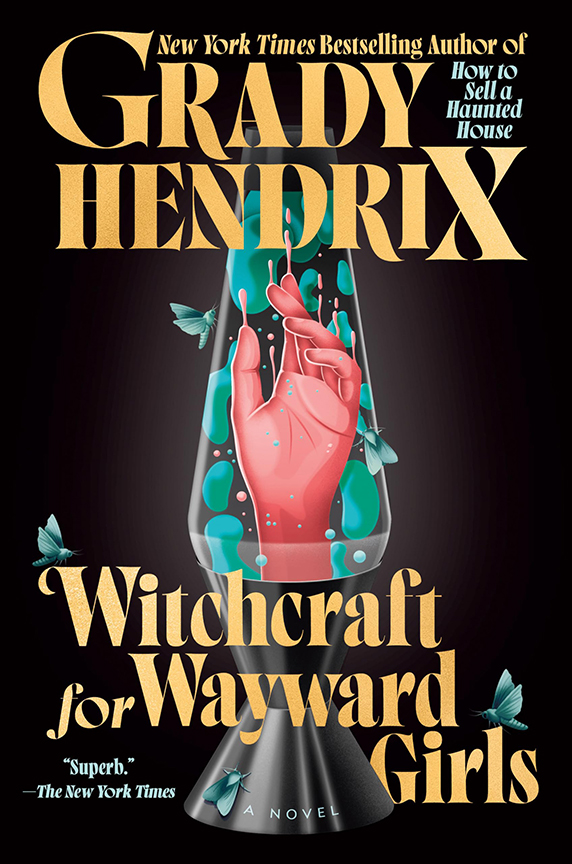
I’ve been a fan of Grady Hendrix since Horrorstör, his ingenious novel that somehow combines supernatural horror with an Ikea catalog. I thought, this is an author to watch. Based on his subsequent work, I was right.
Hendrix always writes with fierce originality, heart, humor, and genuine frights. With Witchcraft for Wayward Girls, however, he takes all those attributes and amplifies them with a layer of righteous indignation at the historical brutality that forms the basis of his story. This is, to my mind, his most humane, deeply felt, and downright best novel to date, and that’s saying something.
Beginning just after World War II, and continuing until the passage of Roe vs. Wade, unwed teenage girls were sent to secret homes to have their babies in shame, and then were coerced into giving the babies up for adoption. The girls were forced to live controlled, regimented lives, told constantly that they were loose, wayward, unworthy of love, even if the pregnancy was the result of rape.
When fifteen-year-old Fern (not her real name—the girls are forbidden from using their real names) arrives at Wellwood House in St. Augustine, Florida, in 1970, she’s a tangled mess of shame and guilt. She just wants to have the baby and forget it ever happened. The girls she meets their—Zinnia, who’s convinced her baby daddy loves her, Rose, a fledgling hippy, Holly, most heartbreaking of all, just turned fourteen, and many others—alter her worldview in profound ways. They fight and argue, but they also support and lift each other up.
Together, the girls try, in subtle and not so subtle ways, to rebel against the adults in charge, to remind themselves that they have worth, but it’s an uphill battle. And then a visiting bookmobile librarian hands Fern a book on witchcraft. Desperate for agency, for a way to take control over their lives, Fern and her small circle begin to dabble in the occult.
Hoping for a little power against their oppressors, they soon realize they’ve unleashed something far bigger, and far more dangerous.
Witchcraft for Wayward Girls reminded me, in important ways, of one of my favorite reads of the last several years, The Reformatory, by Tananarive Due. Like that novel, Witchcraft for Wayward Girls takes as a jumping off point a shameful part of America’s past and imbues it with a supernatural twist. And also like that novel, much of the evil in Witchcraft for Wayward Girls is committed by human monsters.
 Dave Writes and Draws